Markets do not move in a straight line. Periods of rising prices are often followed by temporary declines known as market corrections. Whenever the market falls by 10%, 15%, or even 20%, many investors become nervous and start asking the same question:
“Should I invest more now or wait for the market to fall further?”
The answer is not the same for everyone. However, history shows that market corrections often create opportunities for disciplined long-term investors.
✔ How Much Risk Is Too Much? Understanding Your Risk Capacity

In this article, let us understand what market corrections are, why they happen, and how investors can make informed decisions during volatile market conditions in 2026.
What Is a Market Correction?
A market correction generally refers to a decline of around 10% or more from recent market highs.
| Market Movement | Meaning |
|---|---|
| Up to 5% fall | Normal market fluctuation |
| Around 10% fall | Market correction |
| 20% or more fall | Bear Market |
Market corrections are a normal part of investing and occur in almost every market cycle.
Why Do Market Corrections Happen?
Market corrections can occur for various reasons.
Economic Factors
- Rising inflation
- Higher interest rates
- Slower economic growth
- Global economic uncertainty
- Geopolitical tensions
Market Factors
- Excessive market valuations
- Profit booking by investors
- Over-optimism in certain sectors
- Sudden negative news or events
| Factors | Impact on Market |
|---|---|
| Interest Rate Hikes | High Volatility |
| Global Conflicts | Uncertainty |
| Investor Fear | Rapid Selling |
| Overvaluation | Price Correction |
Not every correction signals a crisis. Sometimes markets simply adjust after a period of strong gains.
Common Mistakes Investors Make During Corrections
Panic Selling
Selling quality investments purely out of fear may lock in losses and prevent participation in future recovery.
Trying to Time the Market Bottom
No investor can consistently identify the market bottom. Waiting endlessly for the “perfect entry point” often results in missed opportunities.
Stopping SIP Investments
Many investors discontinue their SIPs when markets fall. Ironically, this is often the time when SIPs can accumulate more units at lower prices.
Investing Entire Cash at Once
Deploying all available funds immediately may increase risk if markets continue to decline.
Following Market Rumours
Social media predictions and market speculation should never replace proper financial planning.
Why Market Corrections Can Create Opportunities
Successful investors often view corrections differently from short-term traders.

Benefits of Market Corrections
✔ Better valuations
✔ More SIP units at lower prices
✔ Opportunity to rebalance portfolios
✔ Potential for long-term wealth creation
Example
Suppose your SIP amount is ₹10,000.
| NAV | Units Purchased |
|---|---|
| ₹100 | 100 Units |
| ₹80 | 125 Units |
When prices fall, the same investment buys more units, improving long-term wealth creation.
“The stock market is a device for transferring money from the impatient to the patient.”
Should You Invest More During Market Corrections?
Before investing additional money, evaluate your personal financial situation.
Consider Investing More If:
✔ You have an adequate emergency fund.
✔ You do not have high-interest debt.
✔ Your investment horizon is at least five years.
✔ Your asset allocation allows additional equity exposure.
✔ You are comfortable with temporary market volatility.
Avoid Investing More If:
✘ You may need the money within the next one or two years.
✘ Your emergency fund is inadequate.
✘ You are nearing retirement and require capital protection.
✘ You are investing solely because others are doing so.
✘ Your portfolio is already heavily concentrated in equities.
✔ Where Should You Invest Lump Sum Money in 2026? Step-by-Step.
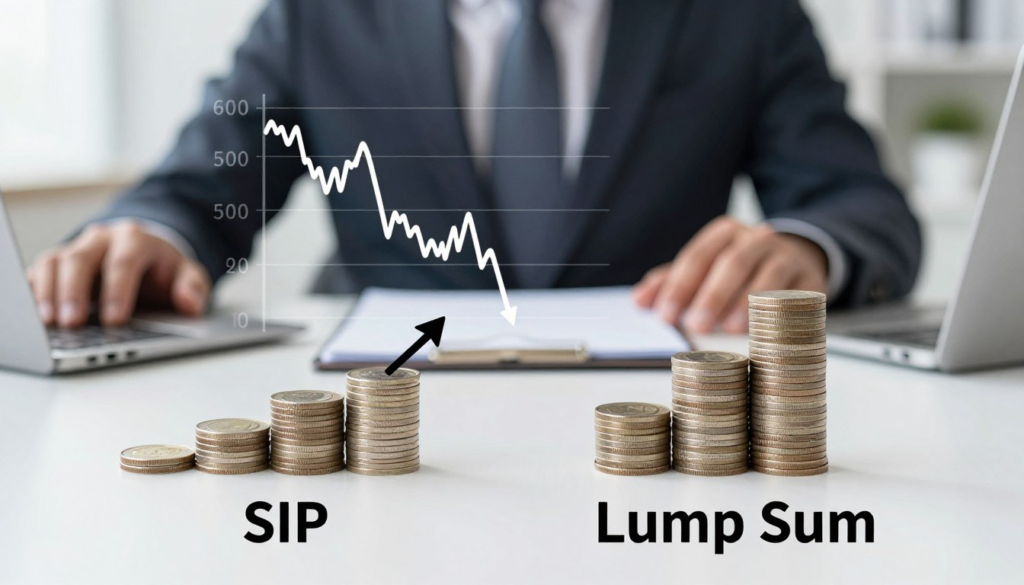
SIP vs Lump Sum During Market Corrections
| Feature | SIP | Lump Sum |
|---|---|---|
| Market Timing | Not Required | Important |
| Risk Level | Lower | Higher |
| Suitable For | Disciplined Investing | Surplus Cash Deployment |
| Volatility Risk | Lower | Higher |
Which Is Better?
For most investors, continuing SIPs and investing additional surplus funds gradually may be the more balanced approach.
If you have a large amount available, consider deploying it in phases rather than investing everything at once.
A Practical Strategy for 2026
Suppose you have ₹1,00,000 available for investment.
Instead of investing the entire amount immediately, consider a phased approach.
| Stage | Amount |
|---|---|
| Invest Immediately | ₹25,000 |
| If Market Falls Further | ₹25,000 |
| On Additional Correction | ₹25,000 |
| Final Deployment | ₹25,000 |
This strategy reduces timing risk while allowing participation in market opportunities.
Do Not Ignore Asset Allocation
Many investors focus excessively on market timing and ignore asset allocation.
In reality, asset allocation often contributes more to long-term investment success than short-term market predictions.
Benefits of Diversification
- Reduced volatility
- Better capital protection
- Improved portfolio stability
- Balanced risk and return
Sample Asset Allocation
| Investor Type | Equity | Debt | Cash |
|---|---|---|---|
| Young Investor | 80% | 15% | 5% |
| Mid-Career Investor | 60% | 30% | 10% |
| Near Retirement | 40% | 50% | 10% |
Portfolio Rebalancing Example
| Asset Class | Target Allocation | Current Allocation | Action |
|---|---|---|---|
| Equity | 60% | 70% | Reduce |
| Debt | 30% | 20% | Increase |
| Cash/Gold | 10% | 10% | Maintain |
✔ Understanding Debt vs Equity Allocation in 2026
What Can Investors Learn from Past Corrections?
Every major market correction has felt uncomfortable while it was happening.
However, investors who remained disciplined, continued investing, and avoided panic decisions have generally benefited when markets recovered.
The lesson is simple:
Market corrections are temporary; financial goals are long term.
Market Correction Action Plan
If markets fall sharply:
✔ Continue SIPs
✔ Maintain your emergency fund
✔ Avoid panic selling
✔ Invest surplus money gradually
✔ Review asset allocation
✔ Rebalance if required
✔ Stay focused on long-term goals
Who Can Benefit Most From Corrections?
Younger Investors
Investors with longer investment horizons may be able to take greater advantage of market declines.
Investors Near Retirement
Investors approaching retirement should prioritise capital protection and balanced asset allocation over aggressive investing.
A Simple Checklist Before Investing More
Before deploying additional money during a correction, ask yourself:
- Do I have at least six months’ emergency expenses?
- Is my existing SIP continuing?
- Do I have any major debt obligations?
- Can I stay invested for at least five years?
- Am I investing based on a plan rather than emotions?
If the answer to most questions is “Yes,” a market correction may offer a reasonable opportunity.
✔ Are You Saving Too Much in 2026?
Final Thoughts
Market corrections are uncomfortable but they are a normal part of investing.
Successful investors do not build wealth by predicting every market movement. They build wealth by maintaining discipline, following asset allocation, continuing investments, and staying focused on long-term goals.
Rather than asking whether the market has reached the bottom, investors should ask whether their financial plan remains strong.
For disciplined investors with adequate liquidity and a long-term investment horizon, market corrections can often become opportunities rather than obstacles.
✔ Where to Stash Your Emergency Fund in 2026
Key Takeaway
Do not invest more simply because markets have fallen. Invest more only if your financial position, risk capacity, and long-term goals support that decision.
A correction may be temporary, but disciplined investing can create wealth for decades.
Frequently Asked Questions (FAQs)
What is considered a market correction?
A fall of around 10% or more from recent market highs is generally considered a market correction.
Should I stop SIPs during a market correction?
Generally no. Corrections allow investors to accumulate more units at lower prices.
Is lump sum investment better during market corrections?
It can be beneficial if surplus funds are available, but phased investing reduces timing risk.
How much money should I invest during a correction?
Only invest money that is not required for short-term goals and after maintaining an adequate emergency fund.
Can a market correction turn into a bear market?
Yes. Some corrections deepen into bear markets. Therefore, diversification and phased investing remain important.
Disclaimer
This publication is intended solely for informational and educational purposes and does not constitute professional, legal, tax, or financial advice. The information provided has been compiled from sources believed to be reliable; however, its accuracy, completeness, or current relevance is not guaranteed. The views and opinions expressed herein reflect the author’s understanding at the time of publication and are subject to change without notice.
Readers are strongly advised to seek independent professional advice before making any decision or taking any action based on the information contained in this publication. The author and publisher expressly disclaim any responsibility or liability for any loss, damage, or consequence arising directly or indirectly from reliance on this content or from any action taken or not taken based on it.