Input Tax Credit (ITC) is one of the fundamental features of the Goods and Services Tax (GST) framework. It enables a registered person, subject to fulfilment of prescribed conditions, to claim credit of GST paid on eligible inward supplies and thereby reduces the cascading effect of taxation.
However, ITC is not an unconditional benefit. Section 16 of the Central Goods and Services Tax Act, 2017 prescribes various conditions that must be satisfied before credit can be availed.
One of the most difficult situations arises when a genuine buyer has:
- received the goods or services;
- received a valid tax invoice;
- paid the supplier, including GST;
- maintained evidence of the transaction; and
- otherwise complied with GST requirements,
but the supplier subsequently fails to deposit the tax with the Government or commits some other GST default.
The buyer may then face reversal or denial of ITC even though the GST amount has already been paid to the supplier.
This gives rise to two separate questions:
First: Can the tax authorities deny ITC to the buyer because of the supplier’s default?
Second: If ITC is ultimately lost because of the supplier’s breach, can the buyer recover that financial loss from the supplier?
These two issues must be examined separately because ITC entitlement under GST law and commercial recovery from a defaulting supplier operate in different legal fields.
Key Takeaway:
Payment of GST to a supplier does not, by itself, guarantee ITC. After the Supreme Court’s 2026 ruling in Bhandari Scrap Traders, businesses should closely monitor supplier compliance, Rule 37A reversals, GSTR-2B reconciliation and contractual safeguards. Where supplier default ultimately causes a financial loss, recovery from the supplier is a separate contractual/legal issue
1. When Can ITC Be Denied?
ITC may be denied, restricted or reversed for several reasons, including:
Invoice Not Reported by Supplier
Where the supplier does not correctly furnish the invoice details in the prescribed statement of outward supplies, the invoice may not be communicated to the recipient through GSTR-2B, affecting eligibility under Section 16(2)(aa).
Tax Not Paid to the Government
Section 16(2)(c) requires that the tax charged in respect of the supply must actually have been paid to the Government, subject to the provisions of the Act.
This condition becomes particularly significant where the buyer has paid the entire invoice—including GST—to the supplier, but the supplier fails to remit the tax.
Goods or Services Not Actually Received
Possession of an invoice by itself is not sufficient. The recipient must establish actual receipt of the goods or services.
Blocked Credit
Section 17(5) restricts ITC on specified goods and services, subject to the exceptions provided therein.
Defective or Non-Genuine Transactions
ITC may also be disputed where:
- the supplier is found to be non-existent;
- invoices are alleged to be bogus;
- actual movement of goods cannot be established;
- supporting transport documentation is absent; or
- the transaction is alleged to be collusive or fraudulent.
The distinction between a genuine transaction affected by supplier default and a non-genuine or inadequately substantiated transaction is therefore extremely important.
2. Section 16 – Principal Conditions for Availing ITC
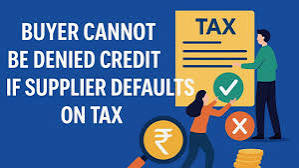
A recipient should broadly ensure that the statutory conditions applicable to the relevant tax period are satisfied, including:
- possession of the prescribed tax invoice or debit note;
- furnishing of invoice/debit-note details by the supplier and communication thereof to the recipient, wherever applicable;
- actual receipt of goods or services or both;
- payment of tax charged on the supply to the Government;
- furnishing of the prescribed return by the recipient;
- compliance with the payment condition applicable where consideration and tax are not paid to the supplier within the prescribed period;
- appropriate treatment where goods are received in lots or instalments;
- compliance with applicable reversal and re-availment provisions;
- non-claiming of depreciation on the GST component of capital goods where ITC is claimed; and
- availment of ITC within the statutory time limit under Section 16(4).
These conditions should not be examined in isolation. The applicable law, rules and return mechanism for the particular financial year must also be considered.
3. The Buyer’s Dilemma – A Practical Example
Suppose a registered business purchases goods for:
| Particulars | Amount |
|---|---|
| Value of goods | ₹10,00,000 |
| GST @ 18% | ₹1,80,000 |
| Total amount paid to supplier | ₹11,80,000 |
The buyer receives the goods and pays ₹11.80 lakh to the supplier.
However, the supplier subsequently fails to deposit the corresponding GST with the Government.
The buyer may then face a dispute regarding ITC of ₹1.80 lakh.
The commercial difficulty is obvious: the buyer has already economically borne the GST by paying it to the supplier but may nevertheless face denial or reversal of the corresponding credit if the statutory conditions are not fulfilled.
Apart from the tax amount, the dispute may also create:
- interest exposure;
- working-capital blockage;
- litigation cost;
- reconciliation difficulties; and
- commercial disputes with the vendor.
Read Also:-
GST Demand Cannot Exceed the Show Cause Notice (SCN)
4. The Critical 2026 Development – Supreme Court in Bhandari Scrap Traders
Any discussion of supplier-default ITC in 2026 must now take into account the Supreme Court’s decision in Bhandari Scrap Traders v. Union of India, delivered on 24 July 2026.
The Supreme Court upheld the constitutional validity of Section 16(2)(c) and affirmed the Gujarat High Court’s view.
The significance of the decision is substantial.
Section 16(2)(c) expressly makes payment of tax to the Government an eligibility condition for ITC. Therefore, merely establishing that the buyer paid GST to the supplier does not, by itself, eliminate the statutory requirement concerning payment of tax to the Government.
Why This Decision Matters
Earlier High Court decisions had provided important relief to bona fide purchasers in particular factual situations, especially where the department proceeded against the purchaser without adequately examining the supplier’s default.
Those decisions remain important for understanding the development of the law and for fact-specific disputes.
However, after the Supreme Court’s July 2026 ruling, businesses should not proceed on the assumption that bona fide conduct alone automatically guarantees ITC where Section 16(2)(c) is not satisfied.
Accordingly, vendor compliance and documentary due diligence have become even more important.
Rule 37A – Reversal and Subsequent Re-availment of ITC
The GST framework also provides a specific mechanism for dealing with certain cases where the supplier has reported an invoice but has not furnished the corresponding GSTR-3B.
Under Rule 37A of the CGST Rules, where ITC has been availed on an invoice or debit note reported by the supplier in GSTR-1/IFF, but the supplier has not furnished the corresponding GSTR-3B by 30 September following the end of the financial year in which such ITC was availed, the recipient is required to reverse the relevant ITC in GSTR-3B on or before 30 November following the end of that financial year.
If the supplier subsequently furnishes the relevant GSTR-3B, the recipient may re-avail the credit in a subsequent GSTR-3B, subject to the applicable provisions.
This mechanism is important because supplier default does not necessarily mean that the credit is permanently lost in every case. Depending upon the nature of the default and subsequent compliance by the supplier, the law may permit re-availment of the reversed ITC.
Practical takeaway: Businesses should separately track Rule 37A reversals vendor-wise and invoice-wise so that eligible credit can be re-availed when the supplier subsequently regularises the relevant compliance.
5. Judicial Evolution – From Bona Fide Buyer Protection to the Supreme Court’s 2026 Ruling
Suncraft Energy Private Limited – Calcutta High Court
The Calcutta High Court granted relief where ITC had been reversed without adequate enquiry against the supplier, despite the purchaser producing supporting material regarding the transaction.
The Revenue’s Special Leave Petition was subsequently dismissed by the Supreme Court.
The case remains an important authority concerning the manner in which ITC disputes involving genuine purchasers should be examined.
Aastha Enterprises – Patna High Court
The Patna High Court took a stricter view of Section 16(2)(c), emphasising that payment of tax to the Government is one of the statutory conditions for ITC.
Sahil Enterprises – Tripura High Court, 2026
The Tripura High Court upheld the constitutional validity of Section 16(2)(c) but provided protection to a bona fide purchaser on the facts before it by reading the provision in a manner that prevented automatic denial merely because of supplier default where the transaction was genuine and non-collusive.
Maruti Enterprise v. Union of India & Others – Gujarat High Court, 2026
The Gujarat High Court upheld the constitutional validity of Section 16(2)(c) of the CGST Act and declined to read down the provision merely to protect a bona fide purchaser where the supplier failed to deposit tax with the Government. The Court emphasised that ITC is a conditional statutory entitlement and also considered the statutory reversal and re-availment mechanism, including Section 41(2) and Rule 37A. It further noted the burden of proving ITC eligibility under Section 155. Accordingly, bona fide conduct or payment of GST to the supplier, by itself, does not override the statutory conditions governing ITC.
Bhandari Scrap Traders – Supreme Court, 2026
The Supreme Court subsequently upheld the validity of Section 16(2)(c) and affirmed the Gujarat High Court’s approach.
A purchaser should not assume that the genuineness of the transaction or payment of GST to the supplier, by itself, overrides Section 16(2)(c). Supplier compliance, the applicable reversal and re-availment provisions, documentary evidence and the facts of each case must be examined together.
Practical lesson: Judicial relief depends heavily upon the applicable period, statutory provisions and evidence surrounding the transaction. A buyer should therefore not rely solely upon the proposition that the supplier was responsible for depositing GST.
6. ITC Eligibility and Recovery from Supplier Are Separate Issues
This distinction should form the foundation of the article:
A contractual right against the supplier does not automatically establish an entitlement to ITC against the Government.
The GST authorities determine ITC eligibility under the CGST/SGST Acts and Rules.
A buyer’s right to recover a financial loss from the supplier, on the other hand, may arise from:
- the purchase agreement;
- purchase order;
- representations and warranties;
- indemnity provisions;
- breach of contractual obligations; and
- other remedies available under applicable commercial law.
Therefore, even where ITC is denied under GST law, the buyer may separately examine whether the resulting loss can be contractually or legally recovered from the supplier.
Read Also:–
ITC Not in GSTR-2B? GST Rules Explained (2026)
7. Can the Buyer Recover Denied ITC from the Supplier?
Potentially, yes—but recovery should not be presented as automatic.
The buyer’s rights will depend upon:
- contractual terms;
- reason for ITC denial;
- conduct of the supplier;
- evidence of supplier default;
- whether the buyer itself contributed to the non-compliance;
- whether the ITC loss has become final;
- existence of an indemnity provision; and
- applicable contractual and commercial law.
Where the supplier has expressly undertaken to comply with GST requirements and its breach causes the buyer an identifiable financial loss, the buyer may examine appropriate contractual remedies.
These could include, depending upon the facts:
- demanding rectification of GST compliance;
- contractual adjustment against amounts payable;
- invoking an indemnity clause;
- claiming damages;
- arbitration where the agreement contains an arbitration clause; or
- appropriate civil/commercial recovery proceedings.
Professional legal advice should be obtained before initiating substantial recovery proceedings.
8. GST Indemnity Clause – An Important Contractual Safeguard
Businesses should consider incorporating an appropriately drafted GST compliance and indemnity clause into vendor agreements and purchase orders.
The clause may require the supplier to:
- maintain valid GST registration;
- issue legally compliant tax invoices;
- correctly report invoices in GST returns;
- discharge applicable GST liability;
- promptly rectify reporting mismatches;
- provide supporting compliance documents where reasonably required; and
- indemnify the recipient against specified losses arising from the supplier’s contractual GST default.
The indemnity may, depending upon negotiated terms, address tax loss, interest, reasonable litigation expenses and other identifiable consequences attributable to the supplier’s breach.
Important: The precise scope and enforceability of an indemnity clause depend upon its wording and applicable law. A professionally drafted clause is preferable to a generic statement in a purchase order.
9. Should the Buyer Withhold the GST Component?
Businesses sometimes provide in their commercial contracts that part of the vendor payment may be retained until specified GST-compliance requirements are satisfied.
However, there is no universal rule that every buyer may automatically withhold the GST component merely because an invoice has not appeared in GSTR-2B.
The right to withhold or adjust payment should be examined with reference to:
- agreed payment terms;
- purchase order;
- vendor agreement;
- applicable law; and
- the nature of the particular default.
Businesses should therefore build appropriate GST-compliance conditions into their contracts instead of adopting arbitrary post-transaction deductions.
The separate statutory consequences of delayed payment to the supplier under the ITC provisions must also be kept in mind.
10. What Should a Buyer Do When a Supplier Default Is Detected?
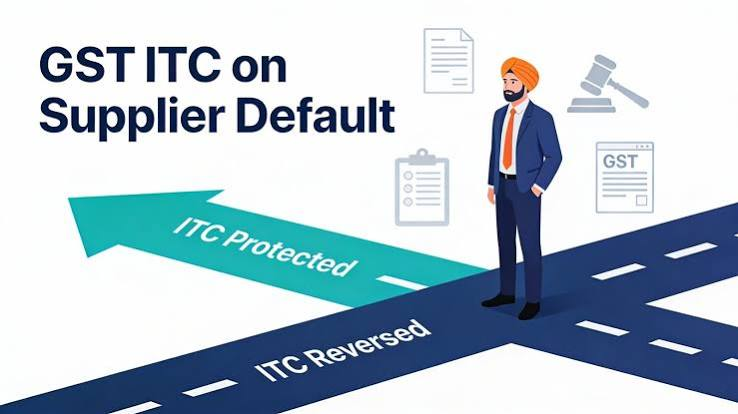
A disciplined escalation mechanism may substantially improve the buyer’s position.
Step 1 – Identify the Exact Mismatch
Determine whether the problem relates to:
- GSTR-1 reporting;
- GSTR-2B reflection;
- supplier tax payment;
- GSTIN cancellation;
- incorrect invoice particulars;
- non-receipt allegations; or
- some other statutory condition.
Step 2 – Contact the Supplier in Writing
Request correction within a specified period.
Step 3 – Preserve Evidence
Maintain complete evidence of purchase, movement, receipt and payment.
Step 4 – Reconcile GST Returns
Ensure that the issue is properly tracked through the relevant GST reconciliation process.
Step 5 – Examine Applicable Circulars and Period-Specific Relief
Certain historical mismatch situations have been dealt with through CBIC circulars and administrative clarifications. Their applicability must be examined according to the relevant financial year.
For historical ITC mismatch cases, Circular No. 183/15/2022-GST dated 27 December 2022 and Circular No. 193/05/2023-GST dated 17 July 2023 should also be examined, wherever applicable to the relevant tax period. These circulars deal with specified historical differences between ITC availed in GSTR-3B and ITC reflected in GSTR-2A and should not be treated as a general relaxation for all current GSTR-2B mismatches.
Step 6 – Respond Properly to Departmental Proceedings
Where an SCN or other communication has been issued, submit documentary evidence rather than relying merely upon ledger entries or the supplier’s invoice.
Step 7 – Examine Commercial Recovery
If supplier default ultimately causes a financial loss, consider contractual recovery separately.
11. Build a “Bona Fide Buyer File”
For substantial transactions, businesses should maintain a documentary trail capable of establishing the genuineness of the transaction.
Procurement Evidence
- Purchase order
- Vendor agreement
- Tax invoice
- Commercial correspondence
Movement and Receipt Evidence
Where applicable:
- E-Way Bill
- Lorry Receipt/transport document
- delivery challan
- gate-entry record
- Goods Receipt Note (GRN)
- weighbridge record
- stock/inventory record
Payment Evidence
- Bank statement
- supplier ledger
- payment advice
- ledger confirmation, where appropriate
GST Evidence
- relevant GSTR-2B records
- GSTIN status verification
- supplier correspondence regarding mismatch
- supporting certificates/declarations where legally relevant
No single document should be treated as universally conclusive. The objective is to establish a consistent chain of evidence demonstrating that the underlying supply was genuine.
12. Vendor Due-Diligence System
ITC risk management should begin before a tax notice arrives.
Businesses should consider implementing the following controls:
- GSTIN verification at vendor onboarding.
- Periodic review of vendor registration status.
- Regular GSTR-2B reconciliation.
- Immediate identification of missing invoices.
- Written vendor follow-up mechanism.
- Escalation for repeated non-compliance.
- Stronger controls for high-value transactions.
- GST compliance and indemnity provisions in vendor contracts.
- Preservation of transport and receipt evidence.
- Periodic vendor-risk review.
A supplier offering a marginally lower price may ultimately become significantly more expensive if its GST non-compliance results in loss of ITC.
13. Accounting Treatment of Disputed ITC
The accounting treatment should depend upon the nature and stage of the dispute.
Temporarily Disputed ITC
Where eligibility is under examination but no final conclusion has been reached, the accounting treatment should appropriately reflect the uncertainty based on the applicable accounting framework and professional assessment.
ITC Reversed but Capable of Re-availment
Where GST law specifically permits subsequent re-availment upon fulfilment of prescribed conditions, the amount should be separately tracked so that eligible credit is not permanently lost merely because of inadequate reconciliation.
Finally Irrecoverable ITC
Where ITC has become permanently inadmissible, appropriate accounting treatment should be determined based upon the nature of the underlying expenditure/asset and applicable accounting and income-tax principles.
Therefore, it is preferable not to state that every irrecoverable ITC must automatically be debited as a general P&L expense. In some situations, its treatment may follow the underlying asset or expenditure.
14. Common Mistakes Buyers Should Avoid
- Claiming ITC without proper GSTR-2B reconciliation.
- Treating possession of an invoice as sufficient proof of entitlement.
- Ignoring repeated supplier compliance failures.
- Failing to maintain evidence of actual receipt of goods/services.
- Depending exclusively upon bank-payment evidence.
- Ignoring retrospective GST-registration issues.
- Missing the statutory ITC time limit.
- Confusing temporary reversals with permanently ineligible credit.
- Using vendor agreements without GST-protection clauses.
- Assuming that a bona fide purchase automatically overrides Section 16(2)(c).
15. Practical Example – From Supplier Default to Recovery
ABC Ltd purchases goods worth ₹5,00,000 plus GST of ₹90,000 from XYZ Ltd.
ABC:
- receives a valid invoice;
- receives the goods;
- records the goods in inventory;
- pays ₹5,90,000 through banking channels; and
- preserves the transport documentation.
XYZ subsequently defaults in its GST obligations.
ABC should not merely wait for departmental action. It should:
- identify the precise GST mismatch;
- immediately communicate with XYZ;
- preserve documentary evidence;
- evaluate the statutory ITC position;
- respond appropriately to any departmental proceeding; and
- if financial loss ultimately arises because of XYZ’s contractual breach, examine recovery under the purchase agreement or indemnity provisions.
This approach recognises the important distinction between defending ITC before the GST authorities and recovering commercial loss from the supplier.
Conclusion
Supplier default has transformed ITC management from a routine return-filing exercise into an important area of tax risk, vendor management and contractual protection.
The Supreme Court’s 2026 decision in Bhandari Scrap Traders makes one principle particularly important: businesses cannot assume that payment of GST to a supplier, by itself, guarantees ITC irrespective of the statutory conditions contained in Section 16.
At the same time, supplier default should not be treated purely as a tax problem.
Businesses should protect themselves through:
- rigorous vendor verification;
- regular GSTR-2B reconciliation;
- strong transaction documentation;
- timely follow-up of mismatches;
- properly drafted GST compliance and indemnity clauses; and
- separate commercial recovery mechanisms where supplier breach causes financial loss.
The most effective ITC defence therefore begins before the purchase is completed—not after the GST notice is received.
Read Also:-
GST Section 73 vs 74 vs 74A: Key Differences Explained (2026)
Frequently Asked Questions
1. Can ITC be denied if the supplier has not paid GST?
Section 16(2)(c) makes payment of tax to the Government one of the conditions governing ITC. The precise consequences should be examined in light of the facts, applicable period and current judicial position, including the Supreme Court’s 2026 decision in Bhandari Scrap Traders.
2. Can a genuine buyer be penalised for the supplier’s default?
The issue is fact-sensitive. Bona fide conduct and strong evidence of genuine supply remain important, but they should not be treated as automatically overriding the statutory conditions for ITC.
3. Can ITC be claimed if an invoice is not reflected in GSTR-2B?
For periods governed by Section 16(2)(aa), reflection/communication of invoice details through the prescribed mechanism is an important eligibility condition. Historical periods may require separate analysis under the law applicable at that time.
4. Can the buyer recover denied ITC from the supplier?
Potentially, depending upon the contractual terms, reason for denial, evidence of supplier breach and applicable commercial law. Recovery is not automatic merely because ITC has been denied.
5. Can GST payment to a non-compliant supplier be withheld?
Only after considering the contractual payment terms and applicable law. Businesses should preferably provide for GST-related retention or adjustment mechanisms in their vendor contracts.
6. Can interest and other losses also be recovered from the supplier?
That depends upon the contract, indemnity clause, causation of loss and applicable law. Such recovery should not be presented as an automatic statutory GST remedy.
7. What documents help establish a genuine purchase?
Tax invoices, purchase orders, transport records, E-Way Bills where applicable, GRNs, stock records, bank-payment evidence, supplier ledgers and commercial correspondence collectively strengthen the evidentiary trail.
8. What if the supplier’s GST registration is subsequently cancelled?
The effective date and circumstances of cancellation, genuineness of the transaction and documentary evidence should be examined carefully. Retrospective cancellation can create ITC disputes but does not eliminate the need for a fact-specific analysis.
9. Is a GST indemnity clause useful?
Yes. A properly drafted indemnity clause can provide an important contractual recovery mechanism where supplier non-compliance causes an identifiable financial loss.
10. What should a buyer do after receiving an ITC mismatch notice?
Identify the exact mismatch, reconcile the relevant GST records, collect transaction evidence, obtain necessary supplier clarification and submit a fact-based response within the prescribed time. Professional advice should be obtained where the amount or legal issue is substantial.
Official References:-
- Central Goods and Services Tax Act, 2017 – Section 16
- CGST Rules, 2017 – Rule 37A
- CBIC Circular No. 183/15/2022-GST dated 27 December 2022
- CBIC Circular No. 193/05/2023-GST dated 17 July 2023
- Supreme Court – Bhandari Scrap Traders v. Union of India, SLP(C) No. 23931/2026, order dated 24 July 2026
- CBIC Circular No. 183/15/2022-GST
- GST Council material on Rule 37A
- Supreme Court of India – Bhandari Scrap Traders listing
Disclaimer
This article is intended for general informational and educational purposes and should not be treated as legal, tax or professional advice. GST provisions, rules, circulars and judicial interpretations may change, and their application depends upon the facts and tax period involved. Readers should verify the latest legal position and obtain appropriate professional advice before acting upon any particular transaction.