Market corrections are a normal part of investing. Although a sudden fall in stock prices can create anxiety, corrections may also provide long-term investors with an opportunity to accumulate quality investments at more reasonable valuations.
However, investing more during a correction should not mean trying to predict the exact market bottom. Market movements are inherently uncertain, and even experienced investors cannot consistently identify the lowest point in advance.
A more practical approach is to remain disciplined, continue regular investments and, where financial circumstances permit, deploy additional funds gradually rather than investing a large amount at once.
For investors navigating the markets in 2026, the key principles remain simple:
- Market volatility is a normal feature of equity investing.
- Panic selling can damage long-term wealth creation.
- Investors should distinguish between an ordinary market correction and a deeper bear market.
- Investment decisions should be based on financial goals, risk tolerance and asset allocation rather than short-term market sentiment.
- Additional investment during a correction should preferably come from genuine surplus funds—not from emergency savings or borrowed money.
- A staggered investment strategy can reduce the risk associated with attempting to time the market.
The real question, therefore, is not simply “Should I buy when the market falls?” but rather:
“Am I financially prepared to invest more, and does doing so fit my long-term investment plan?”
What Is a Market Correction?

A market correction is generally understood as a decline of approximately 10% to 20% from a recent market peak.
Corrections should be distinguished from smaller day-to-day market declines and from more severe market downturns. A decline of 20% or more from a recent peak is commonly described as a bear market, although market terminology can vary depending on the index and context.
A correction may occur when market valuations have risen rapidly, investor expectations change, or economic and geopolitical developments create uncertainty.
Rather than automatically treating every correction as a crisis, long-term investors should examine whether the decline has materially changed the fundamentals of their investments.
In some situations, falling prices may simply mean that fundamentally sound businesses or diversified equity investments are available at lower valuations. In other situations, however, falling prices may reflect genuine deterioration in business fundamentals or economic conditions.
Therefore, a lower price alone does not necessarily make an investment attractive.
A disciplined investment strategy can help investors navigate market corrections without relying on market timing.
Why Do Market Corrections Happen?
Market corrections rarely have a single cause. They can arise from a combination of economic, corporate, geopolitical and investor-behaviour factors.
1. Excessive Market Valuations
When stock prices rise significantly faster than underlying corporate earnings or economic fundamentals, valuations may become stretched.
Even a relatively small change in investor expectations can then trigger profit-booking and bring prices closer to levels that investors consider reasonable.
2. Changes in Economic Conditions
Markets continuously respond to changes in factors such as:
- inflation;
- interest rates;
- economic growth;
- employment conditions;
- liquidity in the financial system; and
- monetary or fiscal policy.
For example, expectations of higher interest rates may reduce the attractiveness of highly valued equities and lead investors to reassess the price they are willing to pay for future earnings.
3. Corporate Earnings Disappointments
Share prices are influenced not only by a company’s current profits but also by expectations regarding its future performance.
If major companies report earnings below expectations, reduce future guidance or face margin pressure, investors may revise their valuations. When this happens across several large companies or sectors, broader market indices may also decline.
4. Geopolitical and Policy Uncertainty
Wars, geopolitical tensions, elections, trade disputes, regulatory changes and unexpected government policies can increase uncertainty.
Markets often react quickly to such developments because investors attempt to estimate their potential impact on economic growth, corporate profitability, inflation and global trade.
5. Profit-Booking and Technical Factors
After a prolonged market rally, both institutional and individual investors may decide to book profits.
Algorithmic trading, stop-loss orders, portfolio rebalancing and other technical factors can sometimes accelerate an existing decline, particularly when market liquidity is weak.
6. Investor Psychology and Media Amplification
Fear and greed play an important role in short-term market movements.
During a sharp decline, continuous negative headlines and falling portfolio values can encourage investors to sell simply because others are selling. This behaviour may temporarily push prices down more rapidly than changes in underlying fundamentals would justify.
For long-term investors, this is precisely why investment decisions should be based on a predefined financial plan rather than daily market headlines.
Are Market Corrections Normal?
Yes. Corrections have occurred repeatedly throughout market history and are an unavoidable part of equity investing.
However, investors should avoid assuming that every correction will be brief or that markets will recover within a predetermined number of months. There is no fixed timetable for a market recovery.
Some corrections reverse relatively quickly, while others develop into prolonged bear markets. The depth and duration of a downturn depend on its underlying causes, economic conditions and investor sentiment.
This uncertainty reinforces an important investing principle:
Do not invest during a correction merely because prices have fallen. Invest because the investment continues to fit your financial goals, risk capacity, time horizon and asset-allocation strategy.
A disciplined investor therefore does not attempt to predict exactly when a correction will end. Instead, the investor prepares in advance for volatility and follows a systematic investment strategy when it occurs.
Correction vs Bear Market vs Market Crash — Know the Difference

The terms market correction, bear market and market crash are often used interchangeably, but they describe different types of market declines.
Understanding the difference is important because the appropriate investor response may vary depending on the severity, speed and underlying cause of the decline.
| Feature | Market Correction | Bear Market | Market Crash |
| Typical Decline | Approximately 10%–20% from a recent peak | Generally 20% or more from a recent peak | No universally accepted percentage; usually refers to a sudden and unusually severe fall |
| Speed of Decline | Usually develops over days, weeks or months | May develop gradually and persist for an extended period | Often occurs rapidly over a short period |
| Duration | May be relatively short, but there is no fixed duration | Can persist for months or longer | Initial fall may be sudden, although its economic and market effects can last much longer |
| Possible Causes | Valuation concerns, profit-booking, interest-rate expectations or temporary uncertainty | Economic slowdown, recession fears, declining earnings or broader financial stress | Severe economic/geopolitical shock, financial-system stress, panic selling or exceptional events |
| Investor Sentiment | Concern and increased volatility | Sustained pessimism and risk aversion | Extreme fear, uncertainty and sometimes disorderly selling |
| Recovery | May recover relatively quickly or develop into a deeper decline | Recovery may take considerable time | Highly variable and dependent upon the cause and subsequent economic conditions |
| Investor Priority | Maintain discipline and review opportunities | Protect liquidity and follow asset allocation | Avoid impulsive decisions and reassess developments carefully |
Important Point
A correction can develop into a bear market, while a sudden crash may itself lead to a prolonged bear market.
These categories should therefore be treated as descriptions of market behaviour—not as reliable predictions about what will happen next.
How Should Investors Respond?
1. During a Market Correction
Approach: Continue regular investments unless your financial circumstances or investment objectives have changed.
Investors with sufficient surplus funds and an appropriate risk profile may consider gradually increasing investments in diversified or fundamentally strong assets.
Mindset: Treat volatility as part of long-term equity investing rather than assuming that every decline represents a financial crisis.
However, a 10%–20% fall does not automatically make every stock attractive. Price and value are not the same thing.
2. During a Bear Market
Approach: Review your portfolio, asset allocation, liquidity requirements and risk capacity before committing significant additional funds.
Where additional investment is appropriate, deploying surplus cash gradually in tranches may be preferable to investing the entire amount at once.
Mindset: Be prepared for an extended period of volatility. Bear markets can test investor patience, and attempting to predict the exact bottom may lead to poor decisions.
Investors should particularly examine whether the businesses or funds they hold continue to meet their original investment rationale.
3. During a Market Crash
Approach: Avoid making large, immediate decisions solely in response to panic.
A sharp fall may create opportunities, but it may also reflect rapidly changing economic or financial conditions. Investors should first assess what has caused the decline and whether the fundamentals of their investments have materially changed.
Mindset: Separate short-term market panic from long-term financial planning.
The objective should not be to “catch the bottom” but to make rational investment decisions based on valuation, diversification, financial goals and risk capacity.
Should You Invest More During a Market Downturn?
Possibly—but not automatically.
A falling market can provide long-term investors with an opportunity to purchase quality investments at lower valuations. However, the decision to invest additional money should depend on the investor’s financial position rather than merely on the percentage by which the market has fallen.
Before investing more, ask:
- Is my emergency fund adequate?
- Do I have high-interest debt that should be addressed first?
- Will I need this money in the next few years?
- Is my existing asset allocation appropriate?
- Can I tolerate a further decline after investing?
- Am I investing in diversified or fundamentally sound assets?
- Am I investing because of a plan—or because I am trying to predict the market bottom?
If these questions have been carefully considered, a market decline may provide an opportunity to gradually deploy surplus capital.
Investing During a Correction
Strategy: Continue your regular SIPs and consider a measured increase in investment if you have surplus funds and adequate risk capacity.
Why: Lower market prices allow the same investment amount to purchase more units. However, investors should recognise that a correction can deepen further.
Possible approach: Diversified equity mutual funds, broad-market index funds or existing long-term portfolio holdings that continue to meet your investment criteria.
Investing During a Bear Market
Strategy: Consider deploying additional surplus cash gradually rather than committing it all at once.
For example, an investor may divide the amount earmarked for equity investment into several tranches and invest progressively. The exact timing and allocation should depend upon the investor’s circumstances rather than an arbitrary formula.
Why: No investor knows in advance how deep or prolonged a bear market will become. Staggering investments can reduce the risk of committing all available capital too early.
Possible approach: Diversified equity funds, broad-market index funds and financially strong companies may be considered after appropriate research and risk assessment.
Investing During a Market Crash
Strategy: Avoid impulsive buying as well as panic selling.
A crash may create attractive valuations, but extreme volatility can make short-term price movements unpredictable. Investors should first assess the cause of the decline and then consider gradual investment where it remains consistent with their long-term plan.
Why: A sudden fall does not guarantee an immediate recovery. Preserving adequate liquidity is particularly important during periods of economic uncertainty.
Tactical Checklist Before Investing More
A simple order of priority can help investors avoid putting essential money at market risk:
Available Surplus Cash → Maintain Emergency Fund → Manage High-Interest Debt → Review Near-Term Financial Needs → Check Asset Allocation → Invest Surplus Gradually
1. Protect Your Financial Foundation
Do not invest money required for essential expenses, emergencies or important near-term financial goals.
An emergency fund should generally be maintained separately from equity investments.
2. Avoid Investing Borrowed Money
A market correction is not a reason to borrow simply because shares appear cheaper.
The market can fall considerably further before recovering, while interest obligations on borrowed money continue irrespective of market performance.
3. Continue Systematic Investments
Investors already following a long-term SIP strategy should avoid stopping it merely because markets have declined, provided their financial circumstances and investment objectives remain unchanged.
4. Use Additional Cash Gradually
If you have genuine surplus funds, consider investing them in stages rather than attempting to identify the exact bottom.
5. Review Asset Allocation
A significant market fall can change the proportion of equity, debt and other assets in a portfolio.
This may provide an opportunity to rebalance the portfolio towards its predetermined asset allocation rather than simply buying more equities indiscriminately.
Read Also :-
How to Rebalance Your Portfolio in 2026: Step-by-Step Guide
6. Control Information Overload
Stay informed about material economic and company-specific developments, but avoid allowing sensational headlines or short-term market commentary to dictate long-term investment decisions.
Benefits of Continuing to Invest During Corrections

One of the most important advantages of continuing a Systematic Investment Plan (SIP) during declining markets is rupee-cost averaging.
When the Net Asset Value (NAV) of a mutual fund falls, the same SIP amount purchases a larger number of units.
For example:
| Month | SIP Amount | NAV | Units Purchased |
| Month 1 | ₹10,000 | ₹100 | 100 |
| Month 2 | ₹10,000 | ₹80 | 125 |
| Month 3 | ₹10,000 | ₹70 | 142.86 |
| Month 4 | ₹10,000 | ₹90 | 111.11 |
The investor continues investing ₹10,000 each month, but purchases more units when prices are lower.
This illustrates an important advantage of systematic investing: the investor does not have to predict the exact market bottom.
Rupee-cost averaging can help manage timing risk, although it does not guarantee profits or protect an investor from losses.
Investor Behaviour During Market Declines
| Investor Action | Typical Behaviour | Possible Long-Term Effect |
| Stopping SIPs out of fear | Reacting to short-term volatility | May miss accumulation at lower prices |
| Continuing planned SIPs | Following a disciplined strategy | Accumulates more units when NAVs are lower |
| Investing additional surplus gradually | Systematic opportunity buying | May improve average acquisition cost |
| Panic selling | Emotion-driven exit | Converts market declines into realised losses |
| Investing all available cash immediately | Attempting to time the bottom | Creates risk if markets decline further |
Potential Advantages of Investing at Lower Valuations
Lower Average Acquisition Cost
When an investor continues purchasing the same diversified investment at lower prices, the average acquisition cost may decline over time.
Greater Participation in a Future Recovery
Units accumulated during lower market levels can participate in any subsequent market recovery.
However, investors should remember that the timing and extent of a recovery cannot be predicted or guaranteed.
Long-Term Compounding Potential
Investments purchased at reasonable valuations and held over sufficiently long periods may benefit from compounding as underlying businesses grow and returns are reinvested.
Potentially Higher Dividend Yield
For dividend-paying companies, a decline in share price can mathematically increase the dividend yield, assuming the dividend remains unchanged.
However, investors should never purchase a stock solely because its dividend yield has increased. During difficult economic conditions, companies may reduce or suspend dividends.
Read Also:-
5 Simple Rules to Build Wealth in 2026 (That 90% Indians Ignore)”
The Key Principle
A market fall should not determine whether you invest. Your financial plan should.
Corrections, bear markets and crashes can create opportunities, but lower prices alone do not make an investment suitable.
The disciplined investor first protects liquidity, maintains an emergency fund, reviews asset allocation and then uses genuine surplus funds to invest gradually in diversified or fundamentally sound investments.
The objective is not to predict the bottom—it is to remain financially prepared when opportunities arise.
Lump Sum vs SIP During Market Corrections
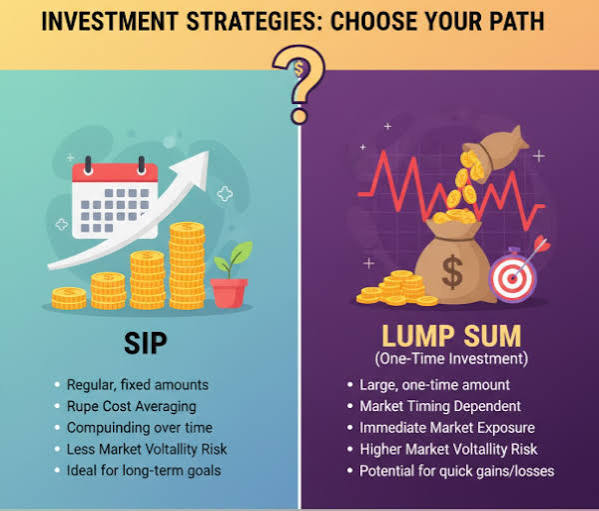
When markets correct sharply, investors with surplus funds often face an important question:
Should I invest the available money as a lump sum, or should I stagger the investment through a SIP or STP?
There is no single answer suitable for every investor.
A lump-sum investment provides immediate market exposure and may perform well if markets subsequently recover. However, it also exposes the entire investment to the risk of further market declines immediately after investment.
A Systematic Investment Plan (SIP) or staggered investment approach spreads purchases across different market levels. This reduces dependence on a single entry point and can make periods of volatility easier to manage psychologically.
The appropriate choice therefore depends on factors such as:
- availability of genuine surplus funds;
- emergency-fund adequacy;
- investment horizon;
- existing asset allocation;
- market valuations;
- risk capacity; and
- ability to tolerate further market declines.
Lump Sum vs SIP — Head-to-Head Comparison
| Feature | Lump-Sum Investment | SIP / Staggered Investment |
| Execution | A substantial amount is invested at one time | Money is invested periodically over time |
| Market Exposure | Immediate exposure of the entire amount | Exposure increases gradually |
| Entry-Point Risk | Higher because the entire investment enters at one market level | Lower because purchases occur at different market levels |
| Benefit During Rising Markets | Entire amount participates in subsequent gains | Part of the money may remain uninvested while markets rise |
| Benefit During Falling Markets | Investment may decline immediately if markets continue falling | Later instalments can purchase more units at lower prices |
| Rupee-Cost Averaging | Not applicable to the initial lump-sum purchase | An important feature of periodic investing |
| Psychological Pressure | May be greater during sharp volatility | Generally easier for investors uncomfortable with large short-term fluctuations |
| Suitable Funding Source | Existing surplus capital | Regular income or capital intended for gradual deployment |
| Primary Consideration | Ability to accept immediate market risk | Discipline to continue investing through volatility |
Important Distinction
A SIP does not automatically generate higher returns or make an equity investment low-risk. It primarily spreads the timing of purchases.
Similarly, a lump-sum investment is not inherently superior merely because the market has corrected.
The eventual result depends upon subsequent market movements, investment selection, valuations, holding period, costs and investor behaviour.
When Can a Lump-Sum Investment Be Considered?
A lump-sum investment may be considered when an investor has substantial surplus capital and is financially capable of tolerating further market declines.
Before doing so, consider the following:
1. The Money Is Genuinely Surplus
Emergency savings, money required for household expenses and funds earmarked for near-term financial goals should generally be kept separate from equity investments.
A market correction should never become a reason to compromise financial security.
2. The Investment Horizon Is Long Enough
Equity markets can remain volatile for extended periods.
Investors considering substantial equity exposure should therefore have an investment horizon appropriate to the risk of the investment and should not depend upon the money for an imminent financial requirement.
3. Asset Allocation Supports Additional Equity
A falling market does not automatically justify increasing equity exposure.
If the investor is already heavily allocated to equities, adding more simply because prices have fallen may increase portfolio risk beyond the desired level.
4. The Investor Can Tolerate Further Declines
A market that has fallen 15% can subsequently fall 20%, 30% or more.
Therefore, an investor considering lump-sum deployment should ask:
“If my investment falls another 20% after I invest, will I still be able to remain invested?”
If the answer is no, gradual deployment may be more appropriate.
Read Also:-
Where to Stash Your Emergency Fund in 2026
Smart Tax Planning Strategies Every Taxpayer Should Know
When Can a SIP or Staggered Approach Be More Suitable?
1. When Investing from Regular Income
For salaried individuals, professionals and other investors receiving periodic income, SIPs provide a simple mechanism for investing regularly without trying to predict market movements.
2. When Market Volatility Is High
When uncertainty is significant, staggering investments reduces dependence on a single entry point.
Some instalments may be invested at higher levels and others at lower levels, thereby averaging the acquisition price over time.
3. When the Investor Is Uncomfortable with Lump-Sum Volatility
Investment behaviour matters.
A theoretically attractive strategy is of little practical value if a sharp decline causes the investor to panic and abandon the plan.
A gradual approach may therefore help some investors remain disciplined during uncertain markets.
The Third Option: Systematic Transfer Plan (STP)
Investors who already possess a large amount of capital but do not want to invest the entire amount in equity immediately may consider a Systematic Transfer Plan (STP), where suitable.
Under an STP, money is generally placed in one scheme—often a relatively lower-volatility fund—and predetermined amounts are periodically transferred into another scheme, such as an equity mutual fund.
This can provide a structured method of gradually increasing equity exposure.
However, investors should remember that an STP is not risk-free or tax-neutral. Transfers between mutual fund schemes are generally treated as redemption from one scheme and investment into another, and the redemption may have tax consequences. Exit loads, taxation and scheme-specific risks should therefore be checked before implementation.
Should You Invest All Your Money at Once?
Not merely because the market has fallen.
Investing all available capital at a single point creates entry-point risk. If the market declines substantially after investment, the entire amount participates in that decline.
On the other hand, keeping investable money outside the market indefinitely also has an opportunity cost if markets rise.
The objective is therefore not to identify a universally perfect entry strategy but to select a deployment method that is consistent with your:
financial goals + liquidity requirements + risk capacity + asset allocation + investment horizon.:-
Read Also:-
Financial Ratios Everyone Must Track in 2026
Situations Where Staggering Capital May Be Sensible
When Valuations or Market Conditions Are Uncertain
Rather than trying to determine whether the market is at its exact peak or bottom, investors may spread investments over several instalments.
This reduces reliance on a single market-timing decision.
When You Receive a Large Windfall
A bonus, inheritance, maturity proceeds or sale proceeds may suddenly create a substantial amount of investable capital.
Deploying such money gradually may be psychologically easier for investors who are uncomfortable exposing the entire amount to equity-market volatility immediately.
The uninvested portion should remain in an instrument appropriate to the investor’s liquidity and risk requirements.
During Exceptional Market Volatility
When markets are experiencing unusually large daily movements, predetermined staggered deployment can prevent investment decisions from becoming reactions to headlines.
There is no universal rule requiring investment after every additional 5% decline. The deployment strategy should instead be decided in advance based on the investor’s financial plan.
Common Mistakes Investors Make During Market Corrections
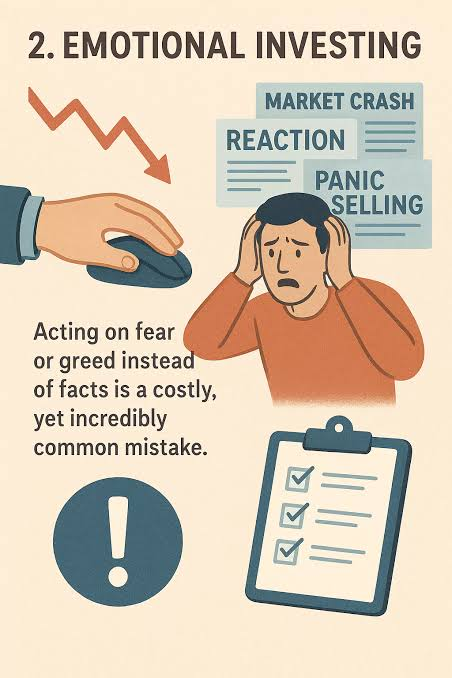
Market corrections test investor behaviour as much as investment knowledge.
Some of the most common mistakes include:
1. Panic Selling
Selling solely because prices have fallen can convert an unrealised decline into a realised loss.
However, selling is not always wrong. Exit may be justified where investment fundamentals have materially deteriorated, the original investment thesis has changed or portfolio rebalancing is required.
The mistake is emotion-driven selling without analysis.
2. Trying to Identify the Exact Bottom
The lowest point of a market decline becomes obvious only in hindsight.
Waiting indefinitely for the “perfect” entry point can result in investors remaining outside the market even after a recovery has begun.
3. Chasing Recent Winners
Buying an investment merely because it has recently generated exceptional returns can expose investors to inflated valuations and concentration risk.
Investment decisions should be based on suitability and fundamentals rather than FOMO—Fear of Missing Out.
4. Ignoring Diversification
Concentrating excessive capital in one company, sector, theme or asset class can significantly increase portfolio risk.
A market correction often reveals concentration risks that were less visible during rising markets.
5. Investing Emergency Money
Money required for essential expenses or emergencies should not be exposed to equity-market volatility.
A financial emergency occurring during a market decline may otherwise force the investor to sell at an unfavourable time.
6. Ignoring Costs and Taxes
Frequent buying and selling can create transaction costs and potential tax consequences.
Mutual fund expense ratios, exit loads, brokerage charges and applicable capital-gains taxation should form part of the investment decision.
7. Ignoring Asset Allocation
A market correction should not automatically lead to indiscriminate equity buying.
Instead, investors should check whether market movements have caused their portfolio to deviate materially from the predetermined allocation among equity, debt, gold and other assets.
Build a Strong Foundation Before the Next Correction
The best time to prepare for market volatility is before it arrives.
1. Maintain an Emergency Fund
Keep an adequate emergency reserve based on your household expenses, income stability, dependants and financial obligations.
While six months of expenses is commonly used as a starting benchmark, the appropriate amount varies from person to person.
The purpose is simple: an unexpected financial requirement should not force you to sell long-term investments during an unfavourable market.
2. Automate Regular Investing
Automatic SIPs can help investors maintain investment discipline regardless of short-term market sentiment.
When NAVs decline, the same SIP amount purchases more units; when NAVs rise, it purchases fewer units.
This is the basic mechanism of rupee-cost averaging.
It reduces dependence on market timing, although it does not guarantee profits or eliminate investment risk.
3. Create an Investment Policy
Investors can document basic rules covering:
- financial goals;
- target asset allocation;
- acceptable risk;
- investment horizon;
- rebalancing policy;
- circumstances for investing additional money; and
- circumstances that would justify selling an investment.
Having predetermined rules can provide a useful reference point when markets become volatile and emotions are elevated.
Read Also:-
Capital Gains Tax in 2026: 5 Costly Mistakes Investors Must Avoid
What Market History Can Teach Investors
Historical market behaviour provides useful lessons, but it should not be converted into guarantees about the future.
Market Declines Are a Normal Part of Equity Investing
Corrections and bear markets have occurred repeatedly across different market cycles.
Investors who choose equities should therefore expect periods of substantial volatility rather than treating every decline as an exceptional event.
Markets Have Historically Recovered from Major Downturns
Major diversified equity indices have historically recovered from many wars, recessions, financial crises and other severe disruptions.
However, past recovery does not guarantee the timing or extent of future recovery, and the experience of an individual stock can be very different from that of a diversified market index.
Some companies never regain their previous highs.
This is another reason why diversification matters.
Missing Strong Recovery Days Can Affect Long-Term Returns
Some of the strongest market advances can occur close to periods of severe market weakness.
Investors who exit during panic and wait for conditions to “feel safe” may therefore miss part of the subsequent recovery.
This does not mean investors should remain invested regardless of circumstances. It demonstrates the difficulty of consistently timing both the exit and subsequent re-entry.
The Economy and Stock Market Are Not the Same
The stock market is forward-looking.
Share prices reflect expectations regarding future earnings, interest rates, economic conditions and investor sentiment. Consequently, markets may begin recovering while current economic data still appears weak.
Similarly, markets can decline even while economic data remains relatively strong if investors expect conditions to deteriorate.
Lump Sum or SIP — The Practical Conclusion
The choice should not be viewed as Lump Sum versus SIP: Which one always gives better returns?
A better question is:
“Which deployment method allows me to remain invested without compromising my financial security or taking more risk than I can tolerate?”
For investors earning regular income, continuing SIPs can provide a simple and disciplined long-term approach.
For investors holding substantial surplus capital, lump-sum investment may be appropriate where the investment horizon, asset allocation and risk capacity support it.
For investors who want to deploy existing capital gradually, a staggered investment strategy or STP may provide a middle path.
The objective is not to invest at the perfect price. The objective is to follow a sustainable investment strategy through different market cycles.
Conclusion
Market corrections are a normal and unavoidable part of long-term equity investing. Although falling portfolio values can be uncomfortable, volatility should not automatically lead investors to abandon a carefully planned investment strategy.
The more important question during a correction is not “How far will the market fall?” but “Does my existing financial plan allow me to take advantage of lower valuations without compromising my financial security?”
Investors should therefore focus on a few fundamental principles:
- Maintain an adequate emergency fund before committing additional money to equities.
- Avoid using borrowed money or funds required for near-term financial goals.
- Continue regular SIPs where the investment remains suitable for your goals and risk profile.
- Consider deploying genuine surplus funds gradually rather than trying to identify the exact market bottom.
- Maintain adequate diversification across asset classes.
- Review asset allocation and rebalance where necessary.
- Distinguish between a temporary decline in market price and a genuine deterioration in investment fundamentals.
- Avoid panic selling based solely on short-term market movements or sensational headlines.
For long-term investors, discipline, diversification and consistency generally matter more than attempting to forecast every market movement.
At the same time, “buy the dip” should never become an automatic investment rule. A falling price does not necessarily mean that an investment has become attractive. Investors should evaluate valuations, fundamentals, financial goals, time horizon and risk capacity before committing additional capital.
Market corrections will come and go. Investors cannot control when they occur, how deep they become or how quickly markets recover.
What investors can control is their savings discipline, diversification, asset allocation, investment costs and behaviour during periods of uncertainty.
Successful long-term investing is therefore less about predicting the next correction and more about building a financial plan capable of surviving one.
Frequently Asked Questions (FAQs)
1. What is a market correction?
A market correction is generally understood as a decline of approximately 10% to 20% from a recent market peak.
Corrections can occur because of changing economic expectations, stretched valuations, interest-rate movements, geopolitical developments, corporate earnings concerns or shifts in investor sentiment.
A correction should not automatically be considered either a buying opportunity or a warning to exit the market. Investors should evaluate the circumstances surrounding the decline and their own investment objectives.
2. Should I continue my SIP when the market is falling?
For a long-term investor whose financial circumstances, goals and chosen investment remain unchanged, continuing a SIP during periods of market volatility can help maintain investment discipline.
When mutual fund NAVs decline, the same SIP amount purchases more units. When NAVs are higher, the same amount purchases fewer units. This is commonly referred to as rupee-cost averaging.
However, rupee-cost averaging does not guarantee profits or protect against losses. Investors should periodically review whether the underlying investment remains suitable for their objectives and risk profile.
3. What is the best investment strategy during a market correction?
There is no single strategy suitable for every investor.
A practical approach may include:
- continuing planned SIPs;
- maintaining an adequate emergency fund;
- avoiding high-interest borrowing for investment;
- reviewing asset allocation;
- rebalancing where appropriate;
- deploying additional surplus funds gradually; and
- focusing on diversified or fundamentally sound investments.
The appropriate strategy depends upon the investor’s goals, time horizon, liquidity requirements and risk capacity.
4. Is it a good idea to buy stocks during a market correction?
A correction can create opportunities, but a lower share price does not automatically mean better value.
Before purchasing an individual stock, investors should examine factors such as the company’s business model, earnings, debt levels, cash flows, competitive position, valuation and future prospects.
Investors who do not have the knowledge or time required to analyse individual companies may prefer diversified investment vehicles appropriate to their circumstances rather than attempting to identify individual “bargain” stocks.
5. Should I invest a lump sum during a market correction?
It depends upon your financial position and ability to tolerate further declines.
Investing a lump sum provides immediate market exposure but also creates greater entry-point risk. The market may decline substantially even after an apparently attractive entry point.
Investors uncomfortable with this risk may consider staggered deployment or, where suitable, an SIP/STP approach.
The decision should be based on asset allocation, investment horizon, liquidity and risk capacity—not simply on how far the market has already fallen.
6. What is the difference between a correction, bear market and market crash?
A correction generally refers to a decline of around 10%–20% from a recent peak.
A bear market is commonly described as a decline of 20% or more from a recent market high.
A market crash does not have a universally accepted percentage definition. It generally describes an unusually rapid and severe market decline accompanied by substantial fear and volatility.
A correction can develop into a bear market, while a sudden crash may also be followed by a prolonged period of market weakness.
7. How should I invest during a market crash?
The first priority during an extreme market decline should be to avoid impulsive decisions.
Investors should review:
- emergency liquidity;
- near-term financial requirements;
- asset allocation;
- investment fundamentals; and
- their ability to withstand further losses.
Investing additional money may be appropriate for some long-term investors with genuine surplus funds, but there is no requirement to invest simply because markets have fallen sharply.
Gradual deployment may help reduce dependence on a single entry point.
8. Could the stock market experience a correction in 2026?
Yes—but no one can reliably predict whether a correction will occur, when it will begin, how deep it will become or how long it will last.
Changes in interest rates, inflation, corporate earnings, valuations, geopolitical conditions and investor sentiment can all contribute to market volatility.
Instead of trying to forecast the next correction, investors may be better served by maintaining appropriate diversification, adequate liquidity and an asset allocation consistent with their financial goals.
9. How does rupee-cost averaging help during market volatility?
Under a regular SIP, an investor contributes a fixed amount periodically.
When NAVs are lower, that amount purchases more units. When NAVs are higher, it purchases fewer units.
This reduces dependence on choosing one particular entry point and can encourage disciplined investing through different market conditions.
However, rupee-cost averaging does not eliminate market risk or guarantee superior returns.
10. Who should not invest additional money during a market correction?
Investing additional money during a correction may not be appropriate for someone who:
- does not have an adequate emergency fund;
- carries substantial high-interest debt;
- needs the money for an important near-term financial goal;
- already has excessive equity exposure;
- has a low tolerance for market volatility; or
- may be forced to withdraw the investment if markets decline further.
Financial stability should generally take priority over attempting to capture a market opportunity.
11. Are market corrections different for retired investors?
Yes. Retired investors may need to exercise greater caution because they may depend upon their portfolios for regular living expenses.
Selling equity investments during a severe downturn to meet expenses can create sequence-of-returns risk, particularly during the early years of retirement.
Maintaining sufficient liquidity and an appropriate allocation among growth, income and relatively stable assets can therefore become especially important for retired investors.
Official References and Further Reading
For current regulations, investor-education material and mutual fund information, readers should preferably refer to official sources such as:
- SEBI Investor — Understanding Mutual Funds — useful for diversification, NAV, SIP/SWP and the regulatory framework.
- AMFI — Systematic Investment Plan (SIP) — directly supports SIP and rupee-cost-averaging discussion, including the important qualification that rupee-cost averaging does not assure profits or protect against losses.
- SEBI Investor — Understanding the Riskometer — is particularly useful because your article repeatedly stresses matching investments with risk capacity.
Disclaimer
This article is intended solely for general informational and educational purposes and should not be construed as investment, financial, legal or tax advice, or as a recommendation to buy, sell or hold any security, mutual fund, financial product or asset class.
Investment in securities and mutual funds is subject to market risks, including possible loss of principal. Past performance, historical market behaviour and previous recoveries do not guarantee future results.
The suitability of any investment strategy depends upon an individual’s financial circumstances, investment objectives, time horizon, liquidity requirements and risk profile.
Readers should conduct their own research and, where appropriate, consult a SEBI-registered investment adviser or other suitably qualified professional before making investment decisions.
While reasonable care has been taken in preparing this article, the author and publisher do not warrant that all information will remain complete, accurate or current and accept no liability for decisions made solely on the basis of this material.