An E-Way Bill (Electronic Way Bill) is an electronically generated document used for tracking the movement of goods under the Goods and Services Tax (GST) framework. It helps establish that the movement of goods is supported by the prescribed documentation and is being carried out in accordance with GST law.
Under Rule 138 of the CGST Rules, 2017, an E-Way Bill is generally required before the commencement of movement of goods where the consignment value exceeds ₹50,000, subject to prescribed exceptions, exemptions and special circumstances.
Failure to generate a valid E-Way Bill, use of an expired E-Way Bill, incorrect vehicle details or discrepancies between the invoice and E-Way Bill may result in interception, detention of goods and conveyance, and other consequences under the GST law.
Therefore, businesses, transporters and tax professionals should understand not only when an E-Way Bill is required, but also how to avoid common compliance errors.
Key Features of an E-Way Bill
1. Electronic Generation
An E-Way Bill is generated electronically in FORM GST EWB-01 on the prescribed E-Way Bill system before the commencement of movement of goods, wherever applicable.
An E-Way Bill may be required for transportation through:
- Road
- Rail
- Air
- Vessel
The compliance requirements may differ depending upon the mode of transportation. Therefore, the applicable provisions should be checked before dispatching the goods.
2. Information Required in FORM GST EWB-01
FORM GST EWB-01 broadly consists of two parts:
Part A – Consignment Details
Part A contains important information relating to the goods and transaction, such as:
- GSTIN of the supplier/consignor
- GSTIN of the recipient/consignee, wherever applicable
- Place of delivery
- Invoice, bill or delivery challan number and date
- Value of goods
- HSN Code
- Reason for transportation
- Transport document details, wherever applicable
Accuracy in Part A is particularly important because errors in the invoice number, GSTIN, value or place of delivery may create discrepancies during interception or verification.
Part B – Transport Details
Part B primarily contains the transportation details, including:
- Vehicle number in case of road transport
- Transport document details, wherever applicable
For transportation by road, the prescribed vehicle details are generally required to be furnished before the movement of goods commences, subject to the exceptions provided under the Rules.
A change in vehicle during transit should also be appropriately updated in the E-Way Bill system wherever required.
3. Who Can Generate an E-Way Bill?
Depending upon the nature of the transaction and responsibility for transportation, an E-Way Bill may be generated by:
- Registered Supplier/Consignor – where the supplier causes the movement of goods.
- Registered Recipient/Consignee – where the recipient causes the movement of goods or in other applicable situations.
- Transporter – where the responsibility for generation or updating transportation details falls upon the transporter.
- E-Commerce Operator or Courier Agency – where duly authorised to furnish the required information on behalf of the consignor.
The E-Way Bill provisions may apply whether the goods are transported through:
- An owned vehicle
- A hired vehicle
- A transporter or logistics service provider
The responsibility for compliance should therefore be determined before the goods are dispatched.
4. Special Situations Requiring Attention
Certain transactions are subject to special E-Way Bill requirements.
For example, where goods are sent by a principal located in one State or Union Territory to a job worker located in another State or Union Territory, an E-Way Bill may be required irrespective of the value of the consignment, subject to the applicable provisions.
Similarly, special requirements apply to movement of goods by rail, air or vessel, and businesses should ensure that the prescribed transport document details are correctly furnished.
5. Unique E-Way Bill Number (EBN)
After successful generation of an E-Way Bill, a unique E-Way Bill Number (EBN) is generated.
The EBN enables the relevant parties—including the supplier, recipient and transporter—to identify and verify the E-Way Bill associated with the movement of goods.
Businesses should ensure that the E-Way Bill details correspond with the underlying invoice, delivery challan and transportation documents.
6. Validity of an E-Way Bill
For goods other than over-dimensional cargo or certain specified multimodal consignments, the validity of an E-Way Bill is generally determined according to the distance to be travelled.
| Distance | General Validity |
| Up to 200 km | 1 day |
| For every additional 200 km or part thereof | 1 additional day |
The validity is calculated in accordance with the prescribed rules from the relevant time of generation of the E-Way Bill.
Different validity rules may apply to over-dimensional cargo and certain specified consignments.
Therefore, the expected travel distance and delivery schedule should be checked carefully before dispatch.
An expired E-Way Bill can create serious difficulties during transit. Where exceptional circumstances prevent delivery within the validity period, the prescribed facility for extension of validity should be examined within the permitted time.
7. Cancellation of an E-Way Bill
Where an E-Way Bill has been generated but:
- The goods are not transported, or
- The goods are not transported according to the details furnished in the E-Way Bill,
it may generally be cancelled electronically within 24 hours of generation, subject to the prescribed conditions.
However, an E-Way Bill cannot ordinarily be cancelled once it has been verified in transit in accordance with the applicable provisions.
Businesses should therefore immediately cancel an incorrectly generated E-Way Bill rather than allowing an incorrect document to remain active.
Key Legal Provisions Governing E-Way Bills
| Provision | Subject | Relevance to E-Way Bill Compliance |
| Rule 138 of the CGST Rules, 2017 | E-Way Bill requirements | Governs the furnishing of information and generation of E-Way Bills before movement of goods in prescribed cases. It covers important requirements relating to consignment and transportation details, subject to specified exceptions and conditions. |
| Section 122 of the CGST Act, 2017 | Penalty for certain offences | Prescribes penalties for specified offences and contraventions under GST. It may become relevant where the facts surrounding transportation or documentation fall within an offence specifically covered by the section. |
| Section 125 of the CGST Act, 2017 | General penalty | Provides for a general penalty where a person contravenes the Act or Rules and no separate penalty has been specifically provided for that contravention. It is also relevant in the context of CBIC’s administrative instructions concerning specified minor E-Way Bill errors. |
| Section 126 of the CGST Act, 2017 | General disciplines related to penalty | Provides important principles for imposing penalties, including treatment of minor breaches and easily rectifiable documentation errors made without fraudulent intent or gross negligence. |
| Section 129 of the CGST Act, 2017 | Detention, seizure and release of goods and conveyances in transit | Applies where goods are transported or stored while in transit in contravention of the GST Act or Rules. It provides the statutory framework for detention/seizure and subsequent release of goods and conveyance. |
Practical Understanding
In simple terms:
Rule 138 → When and how E-Way Bill compliance is required
Section 122 → Penalty for specified offences, where applicable
Section 125 → General penalty where no specific penalty is provided
Section 126 → Principles governing imposition of penalties and minor breaches
Section 129 → Detention, seizure and release of goods/conveyance in transit
Important: Not every E-Way Bill mistake automatically attracts the same penalty. The consequences depend upon the nature of the contravention, materiality of the discrepancy, applicable statutory provision and facts of the particular case.
When Is an E-Way Bill Not Required?
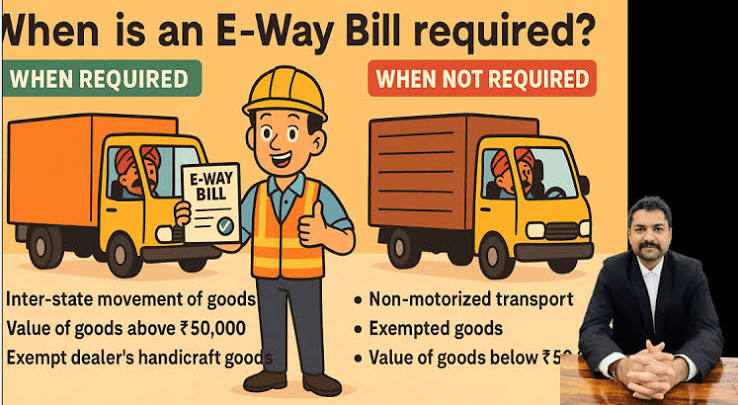
Rule 138 and the applicable notifications provide various situations in which generation of an E-Way Bill is not required.
These may include, subject to prescribed conditions:
- Goods transported from a customs port, airport, air cargo complex or land customs station to an Inland Container Depot (ICD) or Container Freight Station (CFS) for customs clearance.
- Goods transported under customs bond from an ICD to a customs port or from one customs station or customs port to another.
- Goods transported under customs supervision or customs seal.
- Goods specified as exempt from the E-Way Bill requirement under the applicable rules or notifications.
- Certain goods outside the GST levy, including specified petroleum products and alcoholic liquor for human consumption.
- Certain goods specifically covered by the exemptions prescribed under the Rules.
The exemption provisions contain several conditions and specified categories. Therefore, businesses should not assume that an E-Way Bill is unnecessary merely because the goods are exempt from GST.
The latest provisions of Rule 138, relevant annexures and applicable Central/State notifications should always be verified before relying upon an exemption.
Why Can Even a Small E-Way Bill Mistake Lead to Detention?
An E-Way Bill is not merely a procedural document. It forms an important part of the GST mechanism for monitoring the movement of goods.
Where goods are transported in contravention of the GST Act or the Rules, proceedings may be initiated under the applicable provisions, including Section 129 of the CGST Act, depending upon the facts and circumstances of the case.
Common E-Way Bill problems encountered during transportation include:
- Movement of goods without a mandatory E-Way Bill
- Expired E-Way Bill
- Incorrect or incomplete E-Way Bill particulars
- Wrong vehicle number
- Failure to update vehicle details after a change of vehicle
- Mismatch between invoice and E-Way Bill particulars
- Incorrect GSTIN of supplier or recipient
- Missing invoice, bill of supply or delivery challan
- Incorrect place of delivery
- Transportation without the prescribed supporting documents
Even where the underlying transaction is genuine, discrepancies in documentation may result in interception and verification by GST authorities.
However, every clerical or typographical mistake should not automatically be treated at par with deliberate tax evasion. The nature of the discrepancy, supporting documents, consistency of the transaction and surrounding facts can become important in determining the legal consequences.
This distinction between a minor bona fide error and a substantive violation is particularly important while examining penalties and detention proceedings.
The next part of this guide therefore examines the most common E-Way Bill mistakes, applicable penalties, treatment of minor errors, Section 129 proceedings and important judicial principles that businesses should know in 2026.
Consequences of E-Way Bill Non-Compliance
Non-compliance with E-Way Bill provisions can result in serious consequences, particularly where goods are transported without the prescribed documents or where the discrepancies indicate a substantive violation of GST law.
Depending upon the nature and circumstances of the case, the following consequences may arise:
1. Detention of Goods and Conveyance
Where goods are transported in contravention of the provisions of the CGST Act or the Rules, the proper officer may initiate proceedings under Section 129 of the CGST Act and detain or seize the goods and the conveyance used for transportation.
Such proceedings can disrupt the movement of goods and may result in additional transportation, storage and business costs.
2. Penalty and Release Proceedings Under Section 129
Section 129 prescribes the mechanism for release of detained or seized goods and conveyance upon payment of the applicable amount in accordance with the statutory provisions.
The financial consequence can be substantial. Therefore, businesses should not treat E-Way Bill compliance as a mere documentation formality.
The exact liability should always be determined with reference to the law applicable to the relevant transaction and period, as well as the facts of the particular case.
3. Recovery Through Sale or Disposal
Where the amount payable under the detention proceedings is not paid within the prescribed statutory period, the authorities may proceed, subject to the applicable provisions and procedure, towards sale or disposal of the goods or conveyance for recovery of the amount payable.
Accordingly, failure to resolve E-Way Bill detention proceedings promptly can have significant commercial consequences.
Relief for Genuine Clerical and Human Errors
Not every discrepancy in an E-Way Bill necessarily indicates an intention to evade tax.
Recognising that minor clerical mistakes can occur during the preparation of invoices and E-Way Bills, the Central Board of Indirect Taxes and Customs (CBIC) issued Circular No. 64/38/2018-GST dated 14 September 2018.
The Circular provides administrative relief in specified cases of minor errors where the accompanying documents are otherwise substantially correct.
It clarifies that proceedings under Section 129 should ordinarily not be initiated in respect of certain specified minor mistakes.
Examples covered by the Circular include:
- Spelling mistakes in the name of the consignor or consignee where the GSTIN, wherever applicable, is correct.
- Error in the PIN code where the address of the consignor and consignee mentioned in the GST invoice and E-Way Bill is otherwise correct, subject to the conditions specified in the Circular.
- Error in the address of the consignee to the extent that the locality and other details are correct.
- Error in one or two digits of the document number mentioned in the E-Way Bill.
- Error in 4-digit or 6-digit HSN where the first two digits of the HSN are correct and the applicable rate of tax is correct.
- Error in one or two digits/characters of the vehicle number.
This distinction is extremely important because a minor clerical discrepancy should not automatically be equated with deliberate tax evasion or a substantive violation.
Penalty for Specified Minor Errors
For the minor discrepancies specifically covered by the CBIC Circular, instead of initiating detention proceedings under Section 129, a nominal penalty may be imposed under:
- Section 125 of the CGST Act – ₹500, and
- The corresponding provision of the State GST Act – ₹500.
Thus, the combined penalty would generally be ₹1,000 (₹500 CGST + ₹500 SGST) in an intra-State situation covered by the Circular.
The Circular therefore provides important protection against disproportionate action for specified bona fide clerical mistakes.
However, taxpayers should remember that this relief does not mean that every E-Way Bill discrepancy will be treated as a minor error. Material discrepancies relating to the identity of the parties, nature or quantity of goods, value, tax liability, destination or absence of mandatory documents may be viewed differently depending upon the facts.
Key Takeaway
The E-Way Bill is a critical GST compliance document. While the law provides significant consequences for substantive violations, CBIC instructions recognise that genuine and minor clerical mistakes should not ordinarily attract the same treatment as serious non-compliance.
The safest approach is therefore simple:
Generate correctly → Verify before dispatch → Update transport details → Monitor validity → Maintain supporting documents.
This preventive approach can substantially reduce the risk of detention, penalties and disruption of business operations.
Minor Mistakes vs. Major Violations – Comparison at a Glance
| Particulars | Minor Mistakes | Substantive/Major Violations |
| Nature | Specified clerical or typographical discrepancies that do not materially alter the transaction | Material non-compliance affecting the validity or genuineness of the movement |
| Examples | Specified errors in name/address, document number, HSN or vehicle number covered by the CBIC Circular | No mandatory E-Way Bill, material mismatch in goods/documents, false documentation or other substantive non-compliance |
| Detention under Section 129 | Should ordinarily not be initiated for errors specifically covered by CBIC Circular No. 64/38/2018-GST | May be initiated where the statutory conditions are satisfied |
| Penalty for specified minor errors | ₹500 under Section 125 of the CGST Act plus ₹500 under the corresponding SGST Act, as clarified by the Circular | Determined according to the applicable statutory provision and facts of the case |
| Important Provisions | Sections 125 & 126; CBIC Circular No. 64/38/2018-GST | Rule 138 and Sections 122, 129 and other applicable provisions of the CGST Act |
Important: The description “major violation” is used here for practical understanding. The actual legal consequence depends upon the nature of the contravention, applicable statutory provision, supporting documents and facts of each case.
Major or Substantive E-Way Bill Violations
Certain violations are considerably more serious because they may affect the validity, authenticity or tax compliance of the movement itself.
Examples may include:
- Transporting goods without generating an E-Way Bill where it is mandatory.
- Movement with an E-Way Bill that is no longer valid, subject to the facts and circumstances causing the delay.
- Commencing movement without mandatory transport particulars, wherever required.
- Material mismatch between the goods actually transported and the particulars contained in the invoice/E-Way Bill.
- Use of false or fictitious documents.
- Other material discrepancies indicating that the declared transaction may not correspond with the actual movement of goods.
Depending upon the facts, such violations may attract proceedings under Section 129 and other applicable provisions of the CGST Act.
Section 122 may also become relevant where the particular conduct falls within one of the offences specifically covered by that section.
Can Goods Be Detained for a Minor Typographical Error?
Ordinarily, specified minor errors should not result in detention proceedings under Section 129.
CBIC Circular No. 64/38/2018-GST specifically provides administrative guidance for certain minor discrepancies and states that proceedings under Section 129 should not be initiated in the situations covered by the Circular.
This principle is particularly relevant where:
- The transaction itself is genuine.
- The invoice and other documents substantially correspond with the goods.
- Tax treatment is otherwise correct.
- The discrepancy is genuinely clerical and falls within the scope of the Circular.
However, businesses should avoid treating the Circular as a blanket protection for every E-Way Bill error. A discrepancy that materially affects the identity of the parties, goods, value, destination or genuineness of the transaction may require a different legal examination.
Professional Tip
If goods are intercepted solely because of a minor discrepancy apparently covered by CBIC Circular No. 64/38/2018-GST, keep a copy of the Circular readily available and respectfully bring the relevant provision to the notice of the proper officer.
10 Common E-Way Bill Mistakes Businesses Should Avoid
1. Starting Transportation Without a Mandatory E-Way Bill
What Goes Wrong?
Goods are dispatched without generating an E-Way Bill on the assumption that the tax invoice alone is sufficient.
Why Is It Risky?
Where an E-Way Bill is legally mandatory, transportation without it may result in interception and proceedings under the applicable GST provisions.
Relevant Provisions: Rule 138 of the CGST Rules and Section 129 of the CGST Act; Section 122 may apply where the facts fall within a specified offence.
Professional Tip
No vehicle should leave the premises until the applicability and validity of the E-Way Bill have been checked.
2. Incorrect Details in Part A
What Goes Wrong?
Errors may occur in GSTIN, document number, HSN, value, quantity or consignee details.
Why Is It Risky?
A material mismatch between the invoice and E-Way Bill may raise questions during transit verification. At the same time, specified minor errors covered by the CBIC Circular should be distinguished from substantive discrepancies.
Relevant Provision: Rule 138 of the CGST Rules, 2017.
Professional Tip
Reconcile the Invoice/Delivery Challan → E-Way Bill before final submission.
3. Wrong Vehicle Number or Failure to Update Transport Details
What Goes Wrong?
An incorrect vehicle registration number is entered, or the prescribed vehicle particulars are not updated when the vehicle changes during transit.
Why Is It Risky?
Where vehicle particulars are mandatory, incorrect or missing information may create compliance issues during interception.
Remember, however, that certain minor errors in the vehicle number are specifically covered by the CBIC Circular.
Relevant Provision: Rule 138 and the applicable provisions governing updating of vehicle details.
Professional Tip
Treat every change of vehicle as a compliance checkpoint and update the prescribed transport particulars wherever required.
4. Allowing the E-Way Bill to Expire During Transit
What Goes Wrong?
Unexpected circumstances such as traffic congestion, vehicle breakdown, transshipment or natural events delay transportation, but the validity of the E-Way Bill is not appropriately dealt with.
Why Is It Risky?
Movement after expiry may result in interception and examination of whether the transportation was supported by a valid E-Way Bill.
Relevant Provisions: Rule 138(10) and Section 129, where applicable.
Professional Tip
Monitor validity for every long-distance consignment and use the prescribed extension facility wherever legally available.
5. Incorrect Distance
What Goes Wrong?
Incorrect origin-to-destination information results in an inappropriate distance being considered for E-Way Bill purposes.
Why Is It Risky?
Since validity is linked to distance, incorrect information may contribute to validity-related compliance problems.
Relevant Provision: Rule 138(10) of the CGST Rules.
Professional Tip
Verify the PIN codes and system-generated/permitted distance rather than relying solely on manual estimates.
6. Mismatch Between Invoice, E-Invoice and E-Way Bill
What Goes Wrong?
The invoice, E-Invoice/IRN and E-Way Bill contain inconsistent information relating to value, quantity, HSN or other transaction particulars.
Why Is It Risky?
Such inconsistencies can create reconciliation issues and may require explanation during verification or subsequent proceedings.
Relevant Provisions: Rule 48(4), where e-invoicing applies, read with Rule 138.
Professional Tip
Where feasible, integrate the E-Invoice and E-Way Bill generation process to minimise repetitive manual data entry.
A strong documentation trail should ideally be:
Invoice → E-Invoice/IRN, where applicable → E-Way Bill → Transport Document → Proof of Delivery
7. Incorrect Bill-to / Ship-to or GSTIN Details
What Goes Wrong?
The GSTIN, branch, consignee or actual place of delivery is entered incorrectly.
Why Is It Risky?
Material inconsistencies in destination or recipient particulars may raise questions regarding the actual movement of goods.
Relevant Provision: Rule 138 of the CGST Rules.
Professional Tip
Verify the recipient’s GSTIN and carefully review Bill-to / Ship-to particulars before generating the E-Way Bill.
8. Selecting the Wrong Reason for Transportation
What Goes Wrong?
Movement for job work, stock transfer, exhibition, own use or another purpose is incorrectly recorded as a normal supply or under another inappropriate category.
Why Is It Risky?
Incorrect classification of the movement may create inconsistencies between the E-Way Bill and the supporting commercial documents.
Relevant Provision: Rule 138 of the CGST Rules.
Professional Tip
Select the reason for transportation according to the actual nature of movement and ensure that the supporting document reflects the same transaction.
9. Generating Duplicate E-Way Bills
What Goes Wrong?
More than one E-Way Bill is inadvertently generated against the same underlying document because of repeated submissions, system delays or internal communication gaps.
Why Is It Risky?
Duplicate records can create unnecessary reconciliation and verification issues.
Professional Tip
Before generating another E-Way Bill, check whether one has already been successfully generated for the relevant invoice or document. Cancel an unnecessary E-Way Bill within the prescribed time where cancellation is legally permitted.
10. Failure to Cancel an Incorrect E-Way Bill
What Goes Wrong?
An error is discovered after generation, or the proposed movement does not take place, but the E-Way Bill is allowed to remain active.
Why Is It Risky?
Incorrect information remains in the E-Way Bill system and may create avoidable reconciliation or verification issues.
Relevant Provision: Rule 138(9) of the CGST Rules.
Professional Tip
Where cancellation is permissible, cancel the incorrect E-Way Bill within 24 hours of generation and generate a fresh document where required.
Remember that cancellation is subject to statutory conditions and is generally not permitted once the E-Way Bill has been verified in transit.
Mandatory Documents to Carry During Transit
Generating an E-Way Bill is only one part of GST compliance relating to the movement of goods. During transportation, the person in charge of the conveyance must carry the prescribed documents and devices and produce them for verification when required by the proper officer.
Section 68 of the CGST Act, 2017, read with Rule 138A of the CGST Rules, 2017, provides the statutory framework relating to documents and devices to be carried by a person in charge of a conveyance.
Failure to produce the prescribed documents may lead to verification and, depending upon the nature of the contravention and surrounding circumstances, further proceedings under the GST law.
The following documents are particularly important during transit.
1. Tax Invoice / Bill of Supply / Delivery Challan
The person in charge of the conveyance should carry the invoice, bill of supply or delivery challan, as the case may be, in accordance with the applicable GST provisions.
Where a tax invoice is applicable, it should contain the prescribed particulars, including relevant details of the supplier, recipient, document number and date, description of goods, HSN, quantity, value and tax particulars, wherever applicable.
The particulars in the document should correspond with the E-Way Bill.
2. Delivery Challan – Where Applicable
A Delivery Challan may be used for movement of goods in situations where issuance of a tax invoice at that stage is not required or where the GST Rules specifically permit movement under a delivery challan.
Examples may include:
- Goods sent for job work
- Transportation of goods for reasons other than by way of supply
- Transportation of goods in certain SKD/CKD situations
- Other circumstances permitted under the applicable GST provisions
The reason for movement mentioned in the E-Way Bill should be consistent with the supporting document.
3. E-Way Bill / E-Way Bill Number
Where an E-Way Bill is mandatory, the prescribed E-Way Bill details should be available for verification.
Depending upon the permitted mode of compliance, the E-Way Bill Number (EBN) may be carried or made available electronically for verification.
Businesses should ensure that the E-Way Bill remains valid and corresponds with the goods and underlying documents throughout the journey.
4. Relevant Transport Document
Depending upon the mode of transportation, relevant transport documentation should also be properly maintained and made available wherever applicable.
Examples include:
- Lorry Receipt (LR)
- Goods Receipt (GR)
- Railway Receipt (RR)
- Airway Bill (AWB)
- Bill of Lading (BL)
Complete and consistent documentation creates a clear trail from the supplier to the ultimate destination and substantially reduces avoidable difficulties during transit verification.
Recommended Documentation Trail
Invoice/Delivery Challan → E-Invoice/IRN, where applicable → E-Way Bill → Transport Document → Proof of Delivery
Practical Examples: Minor Mistake vs. Substantive Violation
The distinction between a genuine clerical mistake and substantive non-compliance can be better understood through practical examples.
Example 1 – Minor Typographical Error in Vehicle Number
Situation
A supplier generates an E-Way Bill for vehicle DL01AA1234, but due to an inadvertent typing error enters DL01AA1235.
During verification, the invoice, GSTIN, consignee details, nature and quantity of goods and other relevant particulars are found to be consistent. The only discrepancy is one incorrect digit in the vehicle registration number.
Possible Treatment
An error of one or two digits/characters in the vehicle number is one of the minor discrepancies specifically addressed by CBIC Circular No. 64/38/2018-GST, subject to the conditions stated in the Circular.
Accordingly, proceedings under Section 129 should ordinarily not be initiated merely on account of such a specified minor error. The nominal penalty prescribed in the Circular may instead apply.
Learning
A genuine clerical mistake should be distinguished from substantive non-compliance.
The nature of the discrepancy and consistency of the supporting documents are therefore extremely important.
Example 2 – E-Way Bill Expires During Transit
Situation
A truck carrying goods suffers a breakdown during transit. The journey is delayed and the E-Way Bill expires. The transporter subsequently resumes transportation without appropriately dealing with the expired E-Way Bill under the available statutory mechanism.
The vehicle is intercepted after the validity period has expired.
Possible Treatment
The proper officer may examine the validity of the documents and the circumstances responsible for the delay.
Depending upon the facts and applicable provisions, proceedings under Section 129 of the CGST Act may arise.
At the same time, evidence demonstrating a genuine breakdown or other unavoidable circumstances may become important in explaining the delay.
Learning
Businesses and transporters should continuously monitor E-Way Bill validity and use the prescribed extension facility wherever available and applicable.
Read Also:-
GST Section 73 vs 74 vs 74A: Key Differences Explained (2026)
How to Correct an E-Way Bill Mistake
One of the most important practical points to understand is that all E-Way Bill errors cannot simply be edited after generation.
The appropriate corrective action depends upon:
- The nature of the error
- Whether the goods have commenced movement
- Whether cancellation is still permitted
- Whether only transport particulars need updating
- Whether the E-Way Bill has already been verified in transit
Situation 1 – Error Detected Within the Permitted Cancellation Period
Where an incorrect E-Way Bill has been generated and cancellation is legally permissible:
- Log in to the E-Way Bill system.
- Select the appropriate cancellation facility.
- Enter the relevant E-Way Bill Number (EBN).
- Provide the prescribed reason for cancellation.
- Cancel the incorrect E-Way Bill within the permitted period.
- Generate a fresh E-Way Bill with the correct particulars before movement, wherever required.
An E-Way Bill may generally be cancelled within 24 hours of generation, subject to the prescribed conditions.
Cancellation is generally not permitted where the E-Way Bill has already been verified in transit in accordance with the Rules.
Situation 2 – Vehicle Changes During Transit
A change of vehicle due to breakdown, transshipment or another genuine reason does not necessarily require alteration of the underlying transaction details.
Where permitted, the prescribed vehicle particulars should be updated on the E-Way Bill system before further movement.
Professional Tip
Treat every vehicle change as a mandatory internal compliance checkpoint.
The logistics team should not allow the replacement vehicle to proceed until the required transport details have been appropriately updated.
Situation 3 – Error in Core Part A Particulars
Greater care is required where an error relates to important transaction particulars such as:
- GSTIN
- Document/invoice details
- Value
- Quantity
- HSN or description
- Place of delivery
- Nature/reason for movement
Part A particulars generally cannot simply be edited after generation of the E-Way Bill.
Where such an error is discovered, businesses should first determine whether cancellation and generation of a fresh E-Way Bill is legally available.
Where the permitted cancellation period has already expired or the E-Way Bill has been verified in transit, the taxpayer should not attempt an artificial correction merely to make the documents appear consistent.
Instead, the appropriate course should be determined according to the nature of the error, underlying transaction, supporting documents and applicable GST provisions.
Important Compliance Principle
Never alter the underlying invoice or commercial documentation merely to match an incorrectly generated E-Way Bill unless such alteration is independently permissible under GST law.
Best Practices to Avoid E-Way Bill Penalties
Most avoidable E-Way Bill disputes can be reduced through proper documentation, systematic verification and coordination between billing, dispatch and logistics teams.
A simple internal control system before and during transportation can significantly reduce compliance risk.
- Introduce a Pre-Dispatch Verification System
No vehicle should leave the premises until critical transaction and transport particulars have been checked.
Before dispatch, verify:
- Invoice/document number and date
- GSTIN of the relevant parties
- Description and quantity of goods
- HSN and value
- Place of delivery
- Reason for transportation
- Vehicle registration number
- E-Way Bill validity
- E-Invoice/IRN particulars, wherever applicable
Best Practice
Introduce a simple “Prepared By → Checked By → Dispatched By” control for businesses handling frequent consignments.
This creates accountability and considerably reduces repetitive data-entry mistakes.
2. Reduce Manual Errors Through Technology
Repeated manual entry of the same transaction details increases the possibility of errors.
Where commercially feasible, businesses may consider:
- Integrating accounting or ERP systems with authorised E-Way Bill facilities/APIs.
- Generating E-Way Bills using validated transaction data.
- Integrating E-Invoice and E-Way Bill processes, wherever applicable.
- Using system-based distance and PIN-code validation facilities.
- Introducing automated alerts for E-Way Bill expiry.
Technology should not replace human verification; rather, it should reduce repetitive data entry and strengthen internal controls.
Read Also:-
GST Notices via Portal – Is Upload Enough for Valid Service?
3. Monitor Goods Throughout Transit
E-Way Bill compliance does not necessarily end when the vehicle leaves the supplier’s premises.
During transit, businesses and transporters should monitor:
- Change of vehicle
- Transshipment
- Unexpected delays
- E-Way Bill validity
- Delivery status
Where exceptional circumstances delay transportation, the prescribed facility for extension of validity should be examined and used within the permitted framework.
4. Establish an Error-Correction SOP
Even businesses with strong controls can occasionally make mistakes.
A written Standard Operating Procedure (SOP) should specify:
Error detected → Stop dispatch/further movement where appropriate → Identify type of error → Check whether cancellation/update is legally available → Take corrective action → Document the action taken
Employees should know whom to contact immediately when a discrepancy is discovered.
Quick identification and legally appropriate corrective action can prevent a minor documentation problem from developing into a serious dispute.
5. Preserve Evidence of Genuine Transit Delays
Unexpected events such as:
- Vehicle breakdown
- Accident
- Road blockage
- Natural calamity
- Other unavoidable transportation disruptions
may affect the timely movement of goods.
Where such an event occurs, businesses should preserve appropriate supporting evidence wherever reasonably available, such as:
- Repair/service records
- Towing receipts
- Transporter’s communication
- Photographs
- Breakdown reports
- Other contemporaneous evidence of the delay
Such evidence may become valuable in establishing the genuine circumstances surrounding a delayed consignment.
Key Takeaway
Effective E-Way Bill compliance does not end with generating an E-Way Bill.
It requires four continuing controls:
Accurate Documentation → Pre-Dispatch Verification → Transit Monitoring → Timely Corrective Action
Businesses that establish these basic controls, use technology appropriately and train their billing, dispatch and logistics teams can significantly reduce the risk of detention, penalties, delivery disruption and avoidable GST litigation.
Professional Insight
The best time to identify an E-Way Bill mistake is before the vehicle leaves the premises—not when the vehicle is intercepted.
A two-minute verification before dispatch can save substantial time, cost and unnecessary litigation later.
Landmark High Court Judgments on E-Way Bill Penalties
E-Way Bill disputes frequently arise from clerical mistakes, incorrect vehicle particulars, incomplete information or other procedural lapses.
Indian High Courts have, in several cases, examined whether such discrepancies justify severe penal consequences under Section 129 of the CGST/SGST law, particularly where the underlying transaction is genuine and the supporting documents are otherwise available.
An important principle emerging from these decisions is that the nature and materiality of the discrepancy, surrounding circumstances and evidence relating to the genuineness of the transaction must be carefully examined before imposing serious penal consequences.
The following decisions provide useful guidance.
Important Judicial Decisions at a Glance
| Case | Issue | Court’s Approach | Practical Takeaway |
| M/s Auto Industries v. State of U.P. & Another – Allahabad High Court (2025) | Part B of the E-Way Bill was not filled; the taxpayer attributed the lapse to a technical error. | The Court found that there was no finding of intention to evade tax and quashed the penalty imposed under Section 129(3). | A procedural lapse should be examined in the context of the complete transaction and should not automatically be equated with tax evasion. |
| M/s BMR Enterprises v. State of U.P. & Others – Allahabad High Court (2024) | Discrepancy in the vehicle registration number mentioned in the E-Way Bill. | The Court noted the absence of intention to evade tax and held that the minor discrepancy in the vehicle registration number did not justify penalty under Section 129. | Minor vehicle-number errors should be distinguished from substantive non-compliance. |
| M/s Deco Plywood Industries v. State of U.P. & Others – Allahabad High Court (2024) | Incorrect document/invoice number was mentioned in the E-Way Bill. | The Court treated the discrepancy as a typographical error and emphasised the absence of material demonstrating intention to evade tax. | A genuine typographical mistake in a document number should not automatically attract severe penal consequences. |
| Other E-Way Bill decisions of High Courts | Clerical errors, technical lapses and discrepancies in transit documentation. | Courts have examined the complete factual matrix, including supporting documents and whether the discrepancy was substantive or merely procedural. | Each case must be evaluated on its own facts; the CBIC Circular on specified minor errors also remains highly relevant. |
Note: Judicial decisions are fact-specific. A taxpayer should not assume that every E-Way Bill discrepancy will be protected merely because there is no admitted intention to evade tax. The nature of the violation, statutory requirements and evidence available in each case remain important.
Judicial Principles Emerging from E-Way Bill Decisions
Although every case turns on its own facts, several useful principles can be drawn from judicial decisions dealing with E-Way Bill discrepancies.
1. Minor Errors Should Be Distinguished from Substantive Violations
A typographical or clerical mistake is fundamentally different from transporting goods without mandatory documentation, using false documents or carrying goods materially different from those declared.
The nature and impact of the discrepancy should therefore be examined before serious penal consequences are imposed.
2. Genuineness of the Transaction Is Important
Where the:
- Invoice is genuine,
- E-Way Bill exists,
- Goods correspond with the supporting documents,
- GSTIN and parties are identifiable, and
- Overall movement of goods can be satisfactorily explained,
these circumstances may become important in determining whether the discrepancy is merely procedural or reflects substantive non-compliance.
3. Intention to Evade Tax May Be an Important Factual Consideration
Several High Court decisions have considered the absence of intention to evade tax while granting relief in cases involving E-Way Bill discrepancies.
However, it would be too broad to state that proof of mens rea is an absolute statutory requirement in every proceeding under Section 129.
A safer principle is:
Where the discrepancy is minor or procedural and the transaction is otherwise genuine, the absence of material suggesting tax evasion can be an important factor in determining whether harsh penal action is justified.
4. Technical and Procedural Lapses Require Factual Examination
Portal issues, incorrect data entry and similar procedural lapses should be examined with reference to:
- The underlying invoice
- E-Way Bill particulars
- Goods actually transported
- Tax treatment
- Transport documents
- Explanation of the taxpayer/transporter
- Other surrounding evidence
A technical discrepancy should not automatically be treated as proof of a fraudulent transaction.
5. Proportionality Remains an Important Consideration
GST enforcement should distinguish between a minor compliance lapse and substantive non-compliance.
The consequences imposed should have a reasonable relationship with the nature and seriousness of the default, subject always to the applicable statutory provisions.
6. Every Case Must Be Examined on Its Own Facts
There is no universal rule that every E-Way Bill error is minor—or that every discrepancy warrants detention.
The correct approach is:
Identify the error → Examine the supporting documents → Determine its materiality → Apply the relevant statutory provision/CBIC instruction → Consider applicable judicial precedents.
Key Judicial Takeaway
High Court decisions provide substantial support for the proposition that genuine transactions involving minor or procedural E-Way Bill discrepancies should be distinguished from cases involving substantive non-compliance or tax evasion.
Businesses should therefore maintain complete supporting documentation so that the genuineness of the transaction can be demonstrated immediately if goods are intercepted.
Read Also:-
GST Demand Cannot Exceed the Show Cause Notice (SCN)
Critical Compliance Checklist for ERP & Logistics Teams
| Target Area | Recommended Action | Priority |
| Ship-To GSTIN | Keep ERP/accounting systems ready for the proposed Ship-To GSTIN requirement and await the fresh GSTN implementation date. | Deferred |
| API Integration | Ensure E-Invoice and E-Way Bill API integrations reflect the latest GSTN specifications. | Immediate |
| ERP Master Data | Review customer, consignee, branch and delivery-location master data for accuracy. | Immediate |
| Voluntary Closure | Review the proposed E-Way Bill closure functionality for future process readiness; implementation is currently deferred. | Deferred |
| Driver/Logistics Training | Plan training on the closure mechanism after GSTN announces the revised implementation date and final procedure. | Deferred |
| 180-Day Validation | Introduce system alerts to prevent attempts to generate E-Way Bills against documents outside the permitted system window. | Ongoing |
| 360-Day Monitoring | Monitor long-running consignments to ensure E-Way Bill extensions remain within the system limit. | Ongoing |
| Audit Trail | Reconcile Invoice/E-Invoice → E-Way Bill → Transport Document → Delivery/Closure record. | Ongoing |
Practical Impact for Businesses in 2026
The direction of E-Way Bill compliance is increasingly clear: greater system validation, better identification of the actual movement of goods and stronger digital linkage between invoicing, transportation and delivery.
Businesses should therefore move away from treating E-Way Bill generation as an isolated activity performed by the dispatch department.
A stronger compliance framework connects:
Customer Master Data → Invoice/E-Invoice → E-Way Bill → Transporter → Actual Delivery → Reconciliation
This approach reduces manual errors, strengthens the audit trail and makes it considerably easier to explain a genuine transaction during GST verification.
Latest Update: Proposed E-Way Bill Enhancements Deferred Until Further Notice
Important Update – July 2026
GSTN had earlier proposed two important enhancements to the E-Way Bill system:
- Mandatory capture of “Ship-To GSTIN” in specified Bill-To/Ship-To transactions; and
- Introduction of the Voluntary Closure of E-Way Bill functionality.
These changes were initially proposed to be implemented from 15 June 2026. The implementation was subsequently postponed to 1 August 2026 to provide additional time for system changes, API/ERP readiness, testing and operational preparedness.
However, through a further advisory dated 29 July 2026, GSTN has decided to keep the implementation of these proposed enhancements in abeyance until further notice.
Accordingly, the proposed functionalities did not become effective from 1 August 2026.
Current Position
| Proposed Functionality | Earlier Proposed Date | Current Status |
| Mandatory “Ship-To GSTIN” in specified Bill-To/Ship-To transactions | 1 August 2026 | Deferred until further notice |
| Voluntary Closure of E-Way Bill | 1 August 2026 | Deferred until further notice |
GSTN has indicated that the proposed changes are being reconsidered in light of stakeholder feedback and implementation-related concerns.
A fresh implementation timeline is expected to be communicated separately.
Practical Advice for Businesses
Until a fresh implementation date is officially announced, taxpayers should continue to follow the currently applicable E-Way Bill system requirements.
At the same time, businesses using ERP systems, APIs or automated E-Way Bill processes should remain alert to future GSTN advisories, since these proposed functionalities may be introduced after further review or modification.
Important: Businesses should not treat the mandatory Ship-To GSTIN requirement or Voluntary E-Way Bill Closure facility as effective merely because earlier GSTN advisories mentioned 1 August 2026. The subsequent deferment should be considered while determining the current compliance position.
Timeline at a Glance
20 May 2026 → GSTN announced the proposed enhancements
15 June 2026 → Original proposed implementation
9 June 2026 → Implementation postponed to 1 August 2026
29 July 2026 → Implementation kept in abeyance until further notice
Present Position → Await fresh implementation date from GSTN
Conclusion
An E-Way Bill should not be treated merely as a GST compliance formality—it is a critical document supporting the lawful movement of goods under the GST framework.
Businesses, suppliers and transporters should therefore make E-Way Bill compliance an integral part of their dispatch and logistics controls.
The key lessons are straightforward:
1. Check Applicability Before Dispatch
Determine whether an E-Way Bill is required under Rule 138 of the CGST Rules, 2017, considering the consignment value, applicable exemptions and special situations. This should be verified before movement of goods begins.
2. Match the E-Way Bill With Supporting Documents
Ensure that the E-Way Bill is consistent with the invoice/Bill of Supply/Delivery Challan, E-Invoice/IRN wherever applicable, transport documents and the actual goods being transported.
Particular attention should be given to the GSTIN, document number, HSN, value, quantity, place of delivery and vehicle details.
3. Correct Errors Promptly
Where legally permissible, an incorrect E-Way Bill may generally be cancelled within 24 hours of generation and a fresh E-Way Bill generated where required. Vehicle and transport particulars should also be updated whenever prescribed.
Core Part A particulars generally cannot simply be edited after generation.
4. Distinguish Minor Errors From Substantive Violations
Not every E-Way Bill mistake deserves the same treatment.
CBIC Circular No. 64/38/2018-GST dated 14 September 2018 provides relief for specified minor clerical and typographical errors. However, movement without a mandatory E-Way Bill, false documentation or material discrepancies may lead to more serious consequences.
5. Focus on Prevention
Depending upon the nature of the contravention, proceedings may arise under Sections 122, 125, 129 and other applicable provisions of the CGST Act. Therefore, businesses should not assume that every E-Way Bill mistake attracts the same penalty.
A simple compliance chain can substantially reduce risk:
Generate → Verify → Dispatch → Monitor → Update, where required → Preserve Documents → Reconcile
A two-minute verification before dispatch can prevent substantial delays, detention proceedings and avoidable litigation.
Final Takeaway
GST law requires proper documentation and transparency in the movement of goods, while CBIC instructions and judicial decisions highlight the importance of distinguishing genuine clerical mistakes from substantive non-compliance.
The safest approach is to build accuracy into the dispatch process rather than depend upon explanations after a mistake has occurred.
Verify before dispatch—not after interception.
Frequently Asked Questions (FAQs)
1. Is an E-Way Bill required for every movement of goods?
No. An E-Way Bill is not required for every movement of goods.
It is generally required where the consignment value exceeds ₹50,000, subject to Rule 138 of the CGST Rules, specified exemptions and certain special situations where different requirements may apply.
Therefore, applicability should be determined according to the value, nature of goods, reason for movement and applicable statutory provisions.
2. Can an expired E-Way Bill be extended?
Yes, in prescribed circumstances.
Where goods cannot be transported within the validity period due to exceptional circumstances, the validity may be extended in accordance with the procedure and time limits prescribed under the E-Way Bill provisions.
Businesses should monitor validity during transit rather than waiting until the vehicle is intercepted.
3. Can goods be detained for a typing mistake in the E-Way Bill?
Not every typing mistake should result in detention.
CBIC Circular No. 64/38/2018-GST provides relief for certain specified minor errors, such as particular errors in document numbers, HSN and vehicle numbers.
Where the transaction is otherwise genuine and the discrepancy falls within the Circular, proceedings under Section 129 should ordinarily not be initiated merely because of the specified minor mistake.
However, whether an error is genuinely minor depends upon its nature and the facts of the case.
4. Can the vehicle number in an E-Way Bill be updated?
Yes, where permitted under the E-Way Bill provisions.
Where the vehicle changes because of transshipment, breakdown or another legitimate reason, the prescribed vehicle details can generally be updated on the E-Way Bill system.
The required update should be completed before further movement of goods, wherever applicable.
5. Who is responsible if the transporter makes a mistake?
Responsibility depends upon who was required to furnish or update the particular information and the nature of the contravention.
The supplier, recipient and transporter may have different responsibilities under the E-Way Bill provisions.
For this reason, businesses should clearly define responsibility between their billing, dispatch and logistics teams rather than assuming that every transportation-related error is solely the transporter’s responsibility.
6. What happens if the invoice value and E-Way Bill value differ?
A difference between the invoice and E-Way Bill may lead to verification and require an explanation.
The consequence depends upon the nature and materiality of the discrepancy. A genuine minor clerical error should be distinguished from a substantial difference affecting the actual value, quantity, nature or tax treatment of the goods.
The invoice and E-Way Bill should therefore always be reconciled before dispatch.
7. Is an E-Way Bill required for stock transfers?
It may be required.
E-Way Bill provisions apply to the movement of goods, and their application is not restricted only to ordinary sales.
Accordingly, movement for stock transfer, branch transfer, job work and other specified reasons may require an E-Way Bill where the applicable conditions are satisfied.
The correct reason for transportation should also be selected while generating the E-Way Bill.
8. Can an E-Way Bill be cancelled?
Yes, subject to prescribed conditions.
Where goods are not transported or are not transported according to the particulars furnished in the E-Way Bill, cancellation may generally be made electronically within 24 hours of generation.
However, cancellation is generally not permitted once the E-Way Bill has been verified in transit in accordance with the applicable provisions.
Official References & Further Reading
Readers who wish to examine the statutory provisions and official guidance referred to in this article may consult:
- Central Goods and Services Tax Act, 2017 – particularly Sections 68, 122, 125, 126 and 129.
- Central Goods and Services Tax Rules, 2017 – particularly Rules 138 and 138A relating to E-Way Bills and documents required during transit.
- CBIC Circular No. 64/38/2018-GST dated 14 September 2018 – regarding specified minor errors in E-Way Bills.
- GST / E-Way Bill Portal Advisories – for the latest system-related changes, validations and implementation updates.
- Relevant High Court Judgments discussed in this article for judicial interpretation of E-Way Bill discrepancies and penalty proceedings.
Note: GST provisions, notifications, circulars and portal functionalities are subject to amendment. Readers should verify the latest official position before acting upon the information.
Disclaimer
This article is intended solely for general informational and educational purposes and should not be construed as legal, tax or professional advice.
GST law, rules, notifications, circulars, portal functionalities and judicial interpretations are subject to amendment and change. Although reasonable care has been taken to present the information accurately and on the basis of provisions and developments available at the time of publication, readers should verify the latest statutory provisions, notifications, circulars and official GST/GSTN advisories before taking any action.
Judicial decisions discussed in this article are based on their particular facts and circumstances and should not be treated as universally applicable to every E-Way Bill dispute.
Readers facing a specific E-Way Bill detention, penalty, seizure or other GST proceeding should consider obtaining appropriate professional advice based on the facts of their case.
The author and publisher shall not be responsible for any loss, liability or consequence arising from reliance upon the information contained in this article.