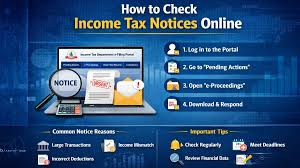
Receiving an income tax notice can create anxiety for any taxpayer. Many people immediately think that a notice means penalty, scrutiny, or wrongdoing. But this is not always true.
In most cases, an income tax notice is simply a formal communication from the Income Tax Department asking for clarification, additional information, correction of mismatch, or payment of tax demand.
In 2026, income tax compliance has become more technology-driven. AIS, TIS, Form 26AS, TDS/TCS data, high-value transactions, bank information, securities transactions, property transactions, and other financial data are now closely matched with the income declared in the ITR.
Therefore, even a small mismatch may result in a notice.
The important point is simple:
Never ignore an Income Tax Notice. Read it carefully, verify the facts, gather supporting documents, and respond within the prescribed time limit.
This article explains a practical step-by-step response strategy for taxpayers who receive an income tax notice in 2026.
What Is an Income Tax Notice?
An income tax notice is a formal communication issued by the Income Tax Department regarding a taxpayer’s income, return, tax payment, refund, mismatch, assessment, or other compliance matter.
It may be issued for many reasons, such as:
mismatch in income reported in ITR and AIS/TIS;
non-reporting of interest income;
incorrect TDS/TCS claim;
defective return;
high-value transaction;
unpaid tax demand;
scrutiny or reassessment;
missing or incorrect details in return.
Receiving a notice does not automatically mean that the taxpayer has committed any default. Many notices are issued only to seek clarification.
Understanding Income Tax Notices – Why Every Taxpayer Should Know About Them
The Income Tax Department has various powers under the Income-tax Act, 1961 to verify the correctness of income reported by taxpayers and to ensure compliance with tax laws. For this purpose, the Department may issue notices seeking information, clarification, documents, or payment of tax and interest.
Receiving an Income Tax Notice does not necessarily mean that the taxpayer has committed any wrongdoing. In many cases, notices are issued for routine verification, clarification of information, or correction of defects in the return filed.
However, every notice must be issued strictly in accordance with the provisions of the Income-tax Act. If a notice is issued without complying with the statutory requirements, it may be challenged and can become legally invalid. Therefore, every taxpayer should understand:
Why a notice has been issued.
The relevant section under which it has been issued.
The time limit for responding.
The consequences of non-compliance.
The available remedies and response options.
Why Are Income Tax Notices More Common in 2026?
The tax system is now highly data-driven. The Income Tax Department receives information from multiple sources, including:
banks;
employers;
mutual fund houses;
stock brokers;
registrars;
property registration authorities;
credit card companies;
foreign remittance data;
TDS/TCS statements;
AIS and TIS records.
Because of this, the department can easily compare the income declared in the ITR with third-party financial data.
For example, if FD interest appears in AIS but is not shown in ITR, the system may automatically generate a mismatch notice.
Common Types of Income Tax Notices
Some of the most commonly issued notices under the Income-tax Act, 1961 are:
Section 139(9) – Defective Return Notice
Section 142(1) – Inquiry Before Assessment
Section 143(1) – Intimation after Processing of Return
Section 143(2) – Scrutiny Assessment Notice
Section 148 – Income Escaping Assessment (Reassessment)
Section 156 – Demand Notice
1. Defective Return Notice(Section 139(9) of the IT Act 1961, corresponding section under the IT Act 2025 is section 263(7)
This notice is issued when the return filed by the taxpayer is incomplete or contains errors.
Common examples:
wrong ITR form selected;
missing mandatory details;
mismatch in schedules;
incomplete balance sheet or profit and loss details;
incorrect claim of deductions.
After the assessee files the return of income, when the assessing officer finds the return filed defective, he sends an intimation to the assessee. Therefore, the assessee is provided with an opportunity to rectify the defect.
In normal cases, the assessee should file a response to the intimation within 15 days of the issue of notice.
However, the assessee can request the assessing officer to relax the time limit, and the assessing officer has the discretion to do so.
Consequence of Non-Compliance of Time Limit
If the assessee does not file a response within the specified time limit, the return that was filed will be treated as invalid. It will be considered as if the assessee has not filed a return at all.
2.Notice under Section 142(1) – Inquiry Before Assessment
(Corresponding Section 268 under the Income Tax Act, 2025)
A notice under Section 142(1) is generally issued when the Assessing Officer requires additional information for completing the assessment proceedings.
The notice may require the taxpayer to:
Produce books of account.
Furnish supporting documents.
Submit statements of assets and liabilities.
Provide specific information in writing.
File the Income Tax Return if it has not been filed.
An important feature of Section 142(1) is that the notice may be issued irrespective of whether the taxpayer has already filed the return of income.
The objective of the notice is to enable the Assessing Officer to collect relevant information before completing the assessment.
Taxpayers should carefully comply with the requirements mentioned in the notice, even if they believe that certain information may not be relevant. Any objection regarding relevance can be raised appropriately during the proceedings, but non-compliance may result in adverse consequences.
If the Assessing Officer is satisfied with the information and explanations submitted, further assessment proceedings may not be required.
Time Limit for Issue of Notice under Section 142(1)
The time limit differs depending upon the purpose of the notice.
1. Notice for Production of Books of Account or Information
(Corresponding Section 268(1)(b) of the Income Tax Act, 2025)
The Assessing Officer may require production of books and records relating to a period up to three years preceding the relevant financial year.Section 268 (2)(b)
For example:
If a notice is issued on 24 May 2025 (during Financial Year 2025-26), the Assessing Officer may call for books relating to Financial Year 2022-23, 2023-24,2024-25, but not earlier years beyond the prescribed limit.
2. Notice Where Return of Income Has Not Been Filed
(Corresponding Section 263 of the Income Tax Act, 2025)
The Act does not specifically prescribe a separate time limit for issuing notice under Section 142(1) where the return of income has not been filed.
However, such notice must ordinarily be issued within the broader statutory framework governing completion of assessment proceedings.
The taxpayer must furnish the information, documents, or return of income within the time specified in the notice.
Failure to comply may lead to:
Best Judgment Assessment under Section 144.
Penalty proceedings.
Further notices and scrutiny.
Additional litigation and compliance burden.
Therefore, every notice under Section 142(1) should be carefully reviewed and responded to within the prescribed time limit.
Practical Tip: Never ignore a notice under Section 142(1). Even if additional time is required for collecting information, respond through the Income Tax Portal and seek an extension wherever permissible. Non-compliance may result in a Best Judgment Assessment under Section 144, which can lead to avoidable tax demands and litigation.
3.Section 143(1) – Intimation on Summary Assessment
(Corresponding Section 270 under the Income Tax Act, 2025)
What is a Summary Assessment?
Simply speaking, a summary assessment is the processing of the return.
Intimation on Summary Assessment
Under the act, it is not mentioned as ‘notice’ but as ‘intimation’. This notice is issued when the assessee has already filed the return on income. If the assessing officer finds certain inconsistencies, as mentioned below, he sends an intimation to the assessee.
Any arithmetical error in the return;
Any claim which is incorrect on the face of it,
Losses of previous financial years for which the return is filed beyond the due date as per section 139(1)
Any expense disallowed in the Tax Audit Report and not disallowed in the income tax computation.
If any deduction is claimed under Chapter VI A or Section 10AA for the financial year in which the return is filed beyond the due date mentioned in Section 139(1)
Usually, these inconsistencies are not found out of deep scrutiny; they are obvious inconsistencies that appear apparently.
The intimation can be issued if the return is filed under section 139(1) or 142(1).
Notice under section 143(1)cannot be sent by the assessing officer after 9 months from the end of the financial year in which the return is filed.
For example, the return of income is filed for FY 2025-26. End of the financial year is 31-03-2026.
9 months from the end of the financial year is 31-12-2026. It is the last date for issuing intimation u/s 143(1) in this case.
Time Limit for Response to Notice
The assessee is supposed to file a response to the intimation received within 30 days of the date the intimation is issued.
If the Assessee files the Response Within 30 Days
His responses will be considered for the computation of income by the assessing officer. The assessing office would verify the correctness and validity of responses received before giving effect to the inconsistencies noted.
If the Assessee files no Response Within 30 Days
The assessing officer will proceed, giving effect to the inconsistencies noted. Failure to respond may result in tax adjustments, additional demand, interest liability, and further proceedings.”
4.Section 143(2) – Notice on Scrutiny Assessment
(Corresponding Section 271 under the Income Tax Act, 2025)
What is Scrutiny Assessment?
This notice is issued when the assessee has not provided any information or when the assessing officer is not satisfied with the information provided by the assessee.
This notice might ask you for the proof of tax deductions, and exemptions claimed, and further information about the profits computed, enabling the officer to conduct a further detailed enquiry.
This is called scrutiny assessment.
Notice under Scrutiny Assessment
The assessing officer might require the assessee to furnish evidence to perform a scrutiny assessment. In this case, he issues a notice under section 143(2)
3 months from the end of the relevant financial year on which the return on income is furnished.
For example, the Return was furnished on 19/02/2025. The financial year ends on 31 March 2025, so the notice needs to be issued by 30 June 2025.
Time Limit for Response to Notice
The response should be submitted by the assessee within the time limit specified in the notice.
Consequence of Non-Compliance of Time Limit
Penal consequences under section 271.
The assessing officer would proceed to assess the income himself, based on whatever information is available. He would demand tax from the assessee as per his calculation, without providing any opportunity for the assessee to explain. This is called the Best Judgement Assessment u/s 144.
Note:
Anyway, we can make a requisition under section 119(2) to the CBDT to relax the time limit. The assessing officer can relax the time limit at his discretion.
5. Section 148 – Notice for Income Escaping Assessment
(Corresponding Section 280 under the Income Tax Act, 2025)
What is Income Escaping Assessment?
The Income Tax Department may sometimes receive information indicating that certain income chargeable to tax was not disclosed by the taxpayer or was not properly assessed in an earlier year.
In such situations, the Assessing Officer has the power to reopen the assessment and reassess the income that is believed to have escaped assessment.
This process is commonly known as Income Escaping Assessment or Reassessment Proceedings.
Income may be considered to have escaped assessment in situations such as:
Income not disclosed in the return of income.
High-value transactions not reported properly.
Information received from other government agencies.
Mismatch in AIS, TDS, SFT, or other databases.
Undisclosed investments, property transactions, or bank deposits.
Cases where no assessment was originally conducted and the statutory time limits permit reopening.
However, reassessment proceedings cannot be initiated merely on suspicion. The Assessing Officer must possess information suggesting that taxable income has escaped assessment.
6. Section 148A – Opportunity Before Reopening
(Corresponding Section 281/284 under the Income Tax Act, 2025)
To strengthen taxpayer rights and reduce arbitrary reassessment proceedings, the law now generally requires the Assessing Officer to follow the procedure prescribed under Section 148A before issuing a notice under Section 148.
Under this procedure:
The taxpayer is issued a Show Cause Notice.
The taxpayer is given an opportunity to explain the facts.
The Assessing Officer considers the explanation and available material.
A speaking order is passed under Section 148A(d).
Only thereafter, if considered necessary, a notice under Section 148 may be issued.
This procedural safeguard is intended to ensure compliance with the principles of natural justice.
Notice under Section 148
A notice under Section 148 requires the taxpayer to furnish a return of income for the relevant assessment year that is proposed to be reopened.
It is important to note that reassessment proceedings cannot ordinarily be initiated merely for conducting a fishing or roving inquiry. The Assessing Officer must have information suggesting escapement of income as required under the law.
Further, issues already adjudicated and pending before appellate authorities are generally governed by separate legal principles and may not be reopened in the same manner.
Time Limit for Issue of Notice under Section 148/148A?
(Corresponding Section 282 under the Income Tax Act, 2025)
The Finance Act has significantly revised the reassessment provisions in recent years.
Cases where Escaped Income is Less than ₹50 Lakh
A notice under Section 148 may generally be issued up to:
3 years and 3 months from the end of the relevant assessment year.
Cases where Escaped Income is ₹50 Lakh or More
Where the Assessing Officer possesses evidence revealing escaped income represented in the form of:
asset,
expenditure,
book entry,
or similar evidence,
and the amount involved is ₹50 lakh or more, the notice may generally be issued up to:
5 years and 3 months from the end of the relevant assessment year.
Taxpayers should always verify the applicable law for the relevant assessment year, as reassessment provisions have undergone multiple amendments in recent years.
Illustration
Suppose the Assessing Officer issues a notice under Section 148 on 15 January 2026.
The taxpayer may be required to furnish the return of income within the period specified in the notice, generally calculated with reference to the statutory provisions and directions contained therein.
Therefore, taxpayers should carefully read the notice and avoid assuming a standard response period in every case.
Time Limit for Response
The taxpayer must furnish the return of income and other information within the time specified in the notice.
The exact period may vary depending upon the facts of the case and the directions contained in the notice.
Accordingly, every reassessment notice should be examined carefully immediately upon receipt.
Consequences of Non-Compliance
Failure to comply with a notice under Section 148 may result in:
Best Judgment Assessment under Section 144.
Additional tax demand.
Interest liability.
Penalty proceedings wherever applicable.
Extended litigation and compliance costs.
Non-compliance may also weaken the taxpayer’s position in subsequent appellate proceedings.
Practical Response Strategy for Taxpayers
If you receive a notice under Section 148:
✔️ Do not panic.
✔️ Verify the assessment year involved.
✔️ Carefully review the reasons and information relied upon by the Department.
✔️ Compare the notice with your original return, AIS, Form 26AS, and supporting records.
✔️ Respond within the prescribed time limit.
✔️ Seek professional advice in complex cases involving reassessment.
✔️ Preserve all correspondence and supporting documents.
Timely and well-documented responses often help resolve reassessment proceedings more effectively and reduce future litigation risks.
Practical Tip
Receiving a notice under Section 148 does not automatically mean that additional tax is payable.
Many reassessment proceedings are successfully explained or contested by taxpayers through proper documentation, factual clarification, and timely compliance.
The key is to respond promptly, understand the basis of reopening, and seek professional assistance wherever required.
7 Section 156 – Demand Notice
(Corresponding Section 289 under the Income Tax Act, 2025)
What is a Demand Notice?
A Demand Notice under Section 156 is issued when the Income Tax Department determines that a taxpayer is required to pay any amount by way of:
Income Tax,
Interest,
Penalty,
Fee,
or any other sum payable under the provisions of the Income-tax Act.
Generally, a Demand Notice is issued pursuant to:
an assessment order,
reassessment order,
rectification order,
penalty order,
or any other order resulting in additional tax liability.
The notice specifies:
✔️ the amount payable,
✔️ the nature of demand,
✔️ the assessment year involved,
✔️ and the time within which payment is required to be made.
In practical terms, a Demand Notice is the formal communication through which the Department seeks recovery of tax dues determined under the Act.
When is a Demand Notice Issued?
A Demand Notice is usually accompanied by an order determining tax liability.
For example:
Assessment under Section 143(3)
Reassessment under Section 147/148
Rectification under Section 154
Penalty proceedings
Other orders creating additional tax liability
The demand notice and the corresponding order should be read together to understand the basis of the demand.
Time Limit for Payment
As a general rule, the taxpayer is required to pay the amount specified in the Demand Notice within 30 days from the date of service of the notice.
However, in appropriate cases:
the Assessing Officer may extend the time for payment,
permit payment in instalments,
or reduce the payment period,
subject to the provisions of the Act and necessary approvals wherever required.
What Should a Taxpayer Do After Receiving a Demand Notice?
Before making payment, the taxpayer should carefully verify:
Step 1 – Check the Demand
Verify whether the demand relates to:
tax,
interest,
penalty,
fee,
or adjustment proposed by the Department.
Step 2 – Compare with Records
Review:
Income Tax Return filed,
Form 26AS,
AIS/TIS,
assessment order,
appellate orders, if any.
Step 3 – Verify Correctness
Confirm whether:
the demand is correct,
tax credit has been properly given,
TDS/TCS has been considered,
previous payments have been adjusted correctly.
Step 4 – Decide Appropriate Action
Depending upon the facts, the taxpayer may:
pay the demand,
file a rectification request,
file an appeal,
seek stay of demand,
or pursue other legal remedies available under the Act.
Consequences of Non-Payment
Failure to pay the demand within the prescribed period may result in:
Interest Liability
Interest may continue to accrue on the outstanding demand in accordance with the provisions of the Act.
Recovery Proceedings
The Department may initiate recovery proceedings, including:
adjustment of refunds,
attachment of bank accounts,
recovery from debtors,
or other modes permitted under the law.
Additional Litigation
Non-payment often results in further notices, recovery actions, and avoidable compliance burden.
Important Practical Point
Many taxpayers assume that every demand notice must immediately be paid.
However, before making payment, it is advisable to verify:
✔️ whether the demand is legally correct,
✔️ whether full tax credit has been allowed,
✔️ whether any rectification is required,
✔️ whether an appeal has already been filed,
✔️ whether a stay application should be considered.
A large number of tax demands are successfully reduced, rectified, or deleted at appellate stages where genuine errors exist.
Practical Tip for Taxpayers
Never ignore a Demand Notice.
Even if you disagree with the demand, appropriate action should be taken within the prescribed time.
Ignoring a demand notice can lead to recovery proceedings, whereas a timely response can help protect your legal rights and avoid unnecessary hardship.
Summary Table:-
Section
Purpose
Response Required
139(9)
Defective Return
Correct defect
142(1)
Information Inquiry
Furnish details
143(1)
Processing Intimation
Verify adjustments
143(2)
Scrutiny Assessment
Submit evidence
148
Reassessment
Respond carefully
156
Demand Notice
Pay or challenge demand
Which Income Tax Notice Requires Immediate Attention?
While every notice issued by the Income Tax Department deserves timely attention, notices under Sections 143(2), 148, and 156 generally require the highest level of vigilance because they may result in scrutiny proceedings, reassessment, or immediate tax recovery. The best approach is simple: never ignore a notice, understand its purpose, verify the facts, and respond within the prescribed time limit.
Step-by-Step Strategy After Receiving an Income Tax Notice
Step 1: Do Not Panic
The first step is to remain calm. Many notices are routine and can be resolved by giving correct details and supporting documents.
A notice becomes serious mainly when it is ignored or replied to casually.
Step 2: Read the Notice Carefully
Check the following points:
notice section;
assessment year;
reason for notice;
amount involved;
documents required;
deadline for response;
whether personal hearing or online reply is required;
whether demand has been raised.
Never reply without understanding the exact issue.
Step 3: Verify Authenticity of the Notice
Before taking action, confirm whether the notice is genuine.
You should verify:
PAN;
name;
assessment year;
DIN number;
date of issue;
issuing authority;
notice available on income tax portal.
A genuine communication from the department generally contains a Document Identification Number.
You can authenticate the notice on the income tax e-filing portal.
How to Authenticate an Income Tax Notice Online
Basic steps:
Visit the income tax e-filing portal.
Go to “Authenticate Notice/Order Issued by ITD”.
Enter details such as PAN, assessment year, notice section, date of issue, mobile number, or DIN.
Verify through OTP.
If the notice is genuine, the portal will confirm its validity.
This step is very important because fake income tax notices and fraudulent communications are also possible.
Step 4: Check AIS, TIS, Form 26AS and ITR
Before drafting the reply, reconcile the notice with:
AIS;
TIS;
Form 26AS;
filed ITR;
bank statements;
TDS certificates;
salary Form 16;
investment statements;
capital gain statements;
property documents;
loan statements.
Many notices arise because the taxpayer did not check AIS/TIS before filing the return.
Step 5: Identify the Real Reason Behind the Notice
Do not give a general reply.
Identify whether the notice is due to:
income mismatch;
TDS mismatch;
deduction claim;
high-value transaction;
defective return;
unpaid demand;
capital gain issue;
business loss or high expenses;
reassessment issue;
non-filing of return.
Once the reason is clear, the reply becomes easier and more effective.
Step 6: Collect Supporting Documents
A good response is always supported by documents.
Depending on the issue, documents may include:
bank statement;
Form 16;
Form 16A;
Form 26AS;
AIS/TIS download;
interest certificate;
capital gain statement;
broker report;
purchase and sale deed;
rent agreement;
donation receipt;
insurance premium receipt;
loan interest certificate;
books of accounts;
GST returns, where relevant for business cases.
Do not upload unnecessary documents. Upload only what is relevant.
Step 7: Prepare a Clear and Professional Reply
Your response should be:
polite;
factual;
structured;
supported by documents;
limited to the issue raised;
submitted within time.
Avoid emotional language like “I am innocent” or “department has wrongly sent notice”.
A professional reply should clearly explain:
facts of the case;
reason for difference, if any;
correct tax position;
supporting documents;
request for acceptance or correction.
Suggested Reply Format
Subject: Response to Income Tax Notice for AY ______
Respected Sir/Madam,
With reference to the notice dated ______ issued for Assessment Year ______, I submit my response as under:
The issue mentioned in the notice relates to ______.
After verifying my ITR, AIS/TIS, Form 26AS and relevant records, I submit that ______.
The reason for the difference is ______.
In support of my submission, I am attaching the following documents:
In view of the above facts and documents, I request that the explanation may kindly be accepted and necessary correction/relief may be granted.
Practical Example: AIS Mismatch Due to FD Interest
Suppose a salaried taxpayer received a notice because FD interest of ₹8,500 appeared in AIS but was not reported in ITR.
Correct approach:
check AIS and bank interest certificate;
verify whether interest was actually earned;
compute additional tax, if payable;
submit explanation;
pay tax if required;
upload supporting document.
Key learning:
Most mismatch notices can be resolved if the taxpayer accepts genuine income, pays due tax if applicable, and replies within time.
Common Reasons for Income Tax Notices
Income tax notices may be issued due to:
non-filing of return;
late filing of return;
mismatch between salary income and Form 16;
mismatch between ITR and AIS/TIS;
TDS/TCS credit mismatch;
high-value cash deposit;
property purchase;
foreign remittance;
capital gain not reported;
dividend or interest income missed;
wrong deduction claim;
excessive refund claim;
business loss without proper explanation;
unpaid tax demand;
income escaping assessment.
Common Mistakes to Avoid
1. Ignoring the Notice
Ignoring a notice is the biggest mistake. It may lead to demand, penalty, or further proceedings.
2. Missing the Deadline
Every notice has a time limit. Delay can weaken your case.
3. Giving Incomplete Reply
A half reply without documents may invite another notice.
4. Not Checking AIS/TIS
Always reconcile AIS/TIS before replying.
5. Copy-Paste Reply
Every notice is different. A generic reply may not answer the actual issue.
6. Uploading Extra Information
Do not provide unnecessary details. Extra information may create new questions.
7. Aggressive Language
Always maintain a polite and professional tone.
8. Handling Complex Matters Without Help
Scrutiny, reassessment, penalty, and high-value transaction cases should be handled with professional support.
When Should You Take Professional Help?
Professional help is advisable where the notice relates to:
scrutiny assessment;
reassessment;
large tax demand;
property transaction;
foreign remittance;
capital gains;
business loss;
unexplained cash deposits;
penalty proceedings;
search or survey related matter;
repeated notices;
legal interpretation.
In small mismatch cases, the taxpayer may handle the reply after proper verification. But in complex matters, expert guidance can prevent bigger disputes.
Important Tips for Taxpayers in 2026
File ITR correctly and on time.
Check AIS/TIS before filing return.
Do not ignore small interest or dividend income.
Keep bank statements and investment records ready.
Match TDS/TCS with Form 26AS.
Report capital gains properly.
Maintain proof for deductions.
Keep acknowledgment of all replies.
Track notices on the income tax portal.
Take professional help where required.
Important Time Limits
Example:
Notice Type
Approximate Action Required
Defective Return Notice
Correct within specified time
AIS/TIS Mismatch
Reply with reconciliation
Demand Notice
Pay or contest within allowed period
Scrutiny Notice
Submit documents/explanation
Reassessment Notice
Detailed legal reply advisable
Documents Checklist
Example:
Documents Commonly Required While Replying
Form 16
Form 26AS
AIS/TIS
Bank statements
Interest certificates
Capital gain statements
Investment proofs
Property papers
Loan certificates
Books of accounts
Never Ignore These Notices–Warning Section
Example:
Notices That Require Immediate Professional Attention
Reassessment notices
Penalty notices
Search/survey related notices
Large tax demands
Foreign asset/income notices
Repeated scrutiny notices
Difference Between Intimation and Scrutiny
Intimation
Scrutiny
Mostly system-generated
Detailed examination
Usually mismatch-based
Officer verification
Limited adjustment
Full explanation/documents required
Less serious
Requires careful handling
Way Forward
The income tax system in India is moving towards complete digital monitoring. Taxpayers should not treat notices as a threat, but as a compliance communication.
The best strategy is:
verify, reconcile, document, reply, and preserve records.
A timely and well-drafted response can resolve most matters at the initial stage itself.
In 2026, taxpayers should be more careful while filing returns because the department already has access to large amounts of financial data through AIS, TIS, Form 26AS and third-party reporting.
Golden Rule for 2026 Taxpayer
The objective of an Income Tax Notice is not always the recovery of tax; in many cases, it is merely acompliance verification mechanism. Taxpayers who maintain proper records, reconcile AIS/TIS before filing returns, and respond promptly to notices can significantly reduce litigation risk.”
FAQs
1. Does receiving an income tax notice mean I have done something wrong?
No. A notice does not always mean wrongdoing. It may be issued only for clarification, mismatch, correction, or additional information.
2. What should I do first after receiving an income tax notice?
First, read the notice carefully and verify its authenticity on the income tax portal.
3. Can I ignore a small income tax notice?
No. Even a small notice should not be ignored. Non-response may lead to demand or further proceedings.
4. What is the most common reason for income tax notices?
AIS/TIS mismatch, TDS mismatch, non-reporting of interest income, and high-value transactions are common reasons.
5. Should I pay the demand immediately?
First verify whether the demand is correct. If it is correct, pay it. If it is wrong, file a response or rectification as applicable.
6. Can I respond to an income tax notice online?
Yes. Most income tax notices are replied to through the income tax e-filing portal.
7. What documents should I attach with my reply?
Attach only relevant documents such as Form 16, Form 26AS, AIS/TIS, bank statement, interest certificate, capital gain statement, or investment proof.
8. When should I consult a tax professional?
You should consult a professional in scrutiny, reassessment, penalty, high-value transaction, capital gains, foreign remittance, or large demand cases.
9. Can AIS data be wrong?
Yes, AIS data may sometimes contain incorrect or duplicate information. In such cases, you should verify the facts and respond properly.
10. What is the best way to avoid income tax notices?
File correct ITR, reconcile AIS/TIS before filing, report all income, claim only genuine deductions, and keep proper records.
Disclaimer
This publication is intended solely for informational and educational purposes and does not constitute professional, legal, tax, or financial advice. The information provided has been compiled from sources believed to be reliable; however, its accuracy, completeness, or current relevance is not guaranteed. The views and opinions expressed herein reflect the author’s understanding at the time of publication and are subject to change without notice.
Readers are strongly advised to seek independent professional advice before making any decision or taking any action based on the information contained in this publication. The author and publisher expressly disclaim any responsibility or liability for any loss, damage, or consequence arising directly or indirectly from reliance on this content or from any action taken or not taken based on it.